
Review · USA
Learn to Surf – Navarre Beach
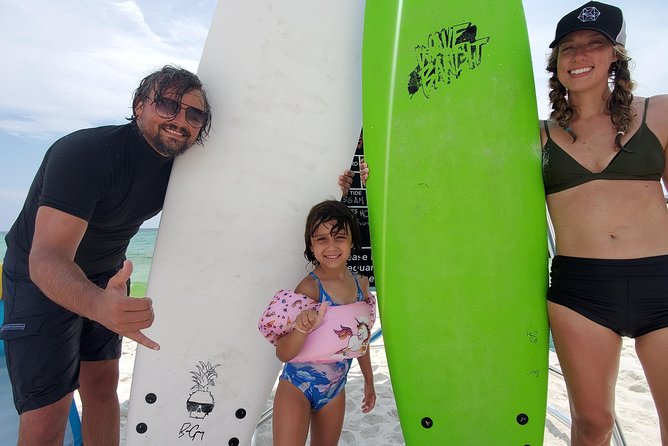
Navarre Beach gives first-time surfers a friendly place to learn, with a lesson built around the basics rather than showy tricks. You start on sand with water safety and etiquette, then work on paddling, the pop-up, and stance before trying waves in the Gulf of Mexico.
I like the small group of no more than 10 and the fact that the board is supplied, so you can try surfing without buying gear. I also like that the instructor stays in the water to help with wave placement and give a push when needed. The main caution is that conditions and instructor reliability matter, so confirm the meeting details before setting out.
Key points at a glance
- A true first lesson: Shore instruction covers prone position, paddling, the pop-up, stance, and ways to get through the water.
- Instruction time matters: The experience lasts about two hours, with roughly 1.5 hours devoted to instruction and board use.
- Boards are included: You do not need to arrange a surfboard rental separately.
- All ages are welcome: The lesson is designed for beginners, though a moderate level of physical fitness is required.
- Small-group attention: The maximum group size is 10, and the instructor helps with line-up placement and catching waves.
- Weather can change the plan: Poor conditions may lead to a new date or a full refund.
Starting at the Navarre Beach Fishing Pier
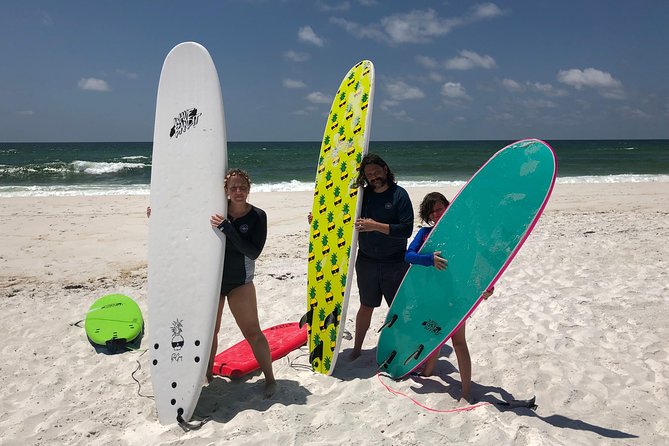
Your meeting point is the Navarre Beach Fishing Pier at 8579 Gulf Boulevard in Navarre, Florida. The activity returns to this same spot, which keeps the plan simple and avoids a separate shuttle or second pickup point.
The lesson is listed during daytime hours, from 9:00 a.m. to 5:00 p.m., Monday through Sunday. Your exact start time comes with the booking, so check it carefully. Surf lessons depend on tide, wind, and wave conditions, and the instructor may adjust the shore portion to suit the day.
Navarre is in the Pensacola area, but the lesson itself takes place at the beach in Navarre. If you are planning to use public transportation, the meeting point is near public transportation according to the activity details. You still need to allow enough time to find the pier and prepare before the start.
One practical warning deserves attention. A past booking included a no-show, with no contact until the customer called the booking company. That does not tell you how often this happens, but it is reason enough to save the provider details, check your confirmation, and make sure you know exactly where to meet.
More Surf Lessons in the USA
- Maui: Two Hour Beginner Group Surf Lesson in Kihei
★ 5.0 · 950 reviews - Open Group Surfing Lesson in Waikiki, Hawaii
★ 4.5 · 582 reviews - Outrageous Surf ScHool Lesson on Lahaina Side
★ 4.5 · 547 reviews
The first lesson happens on the sand
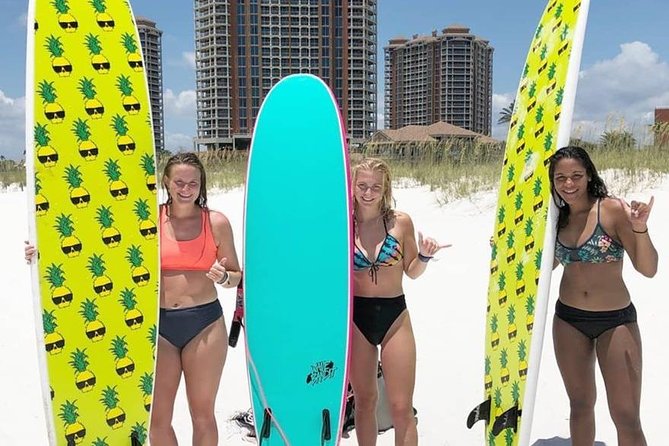
The class begins with a group introduction. Before anyone grabs a board, the instructor gives a report on current conditions and marine life. This is useful for a beginner because the Gulf is not a swimming pool, and knowing what the water is doing helps you make better choices.
Next comes water safety and surf etiquette. You learn the basic rules for sharing the water and handling your board. That part may sound less exciting than catching a wave, but it is one of the most valuable pieces of a first lesson. A beginner who knows where to sit, how to handle a board, and how to avoid trouble is more prepared to enjoy the session.
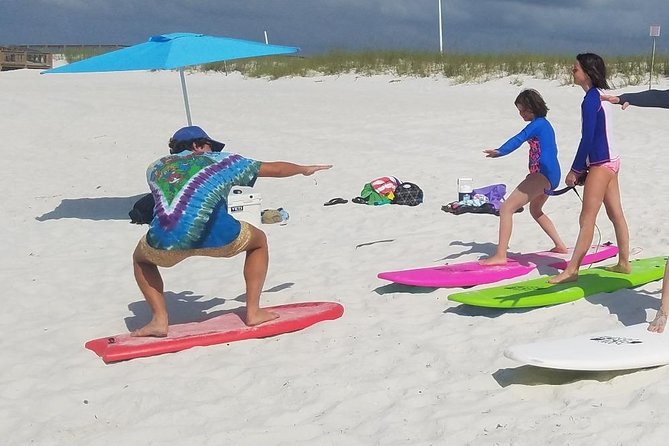
The group then stretches. The shore class covers the prone position, which is how you lie on the board, along with paddling technique. You will also practice the pop-up, the move from lying on the board to standing, and the stance you should use once you are upright.
This land practice gives you a chance to repeat the movements without wave pressure. You can focus on hand placement, timing, and balance before the board starts moving. The lesson is not simply a quick explanation followed by a rental. The instructor uses the beach to build the movements in stages.
Learning how to get through the water
The instructor decides how much time to spend on paddling out based on conditions. That is an important point, since a calm day and a rougher day call for different techniques.
The lesson may cover methods such as duck diving, the log roll, and nose dives. The exact amount of instruction depends on the boards and the conditions, so you should not expect every technique to receive equal attention at every session.
For you, this means the lesson should be responsive rather than rigid. If the water makes paddling out easy, more time can go toward catching waves. If the conditions require care, the instructor can spend longer showing you how to handle the board safely.
You will need a moderate level of physical fitness. Paddling and repeatedly getting to your feet take effort, even in a beginner class. The activity does not say that you need prior surfing experience, and the lesson is open to all ages, but you should be comfortable with a physically active two-hour outing.
From practice to your first wave
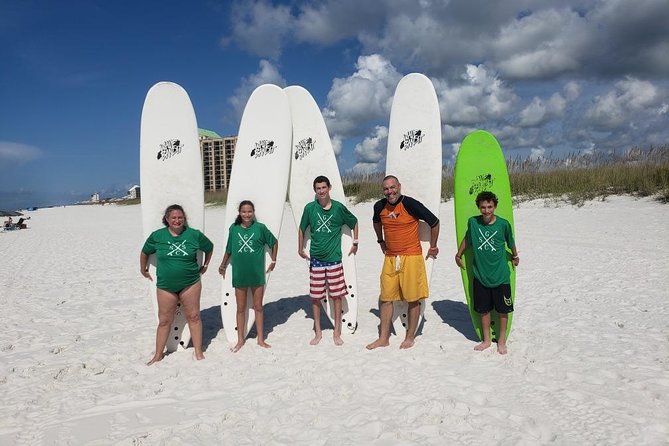
After the shore lesson, you take the board into the water. The instructor helps each surfer with line-up placement, meaning where to position yourself in relation to the waves and the group.
That personal help is a strong part of the lesson. Beginners often struggle less with standing than with knowing where to be. Starting too far inside, too far outside, or in the wrong part of the group can make the session confusing. The instructor’s position in the water lets you receive guidance at the moment you need it.
The instructor may also push you into waves if needed. That can help you feel the board glide before you have mastered all the paddling timing yourself. You still need to work on the pop-up and stance, but the push can give you an early success and show how the board feels when a wave carries it.
The experience has included instructors named Kai and Brandon. Kai has been especially effective with teenage beginners, while Brandon is described as encouraging, clear, and careful with first-time families. Instructor availability can change, so do not assume one of those two will teach your particular session. Still, their approach gives you a useful idea of what to look for: clear shore instruction, patient correction, and close attention in the water.
Same coast, a different way into the water:
- Dolphin and Manatee Stand Up Paddleboard Tour in Daytona Beach
★ 5.0 · 2,328 reviews - Oahu North Shore Experience: Activities, Waterfall & Free Time
★ 5.0 · 1,799 reviews - Raccoon Island: Exploration on SUP/Kayak
★ 4.8 · 1,289 reviews - Dolphin, Manatee and SeaTurtle SUP Adventure Tour of St Augustine
★ 5.0 · 1,219 reviews
Why a small group makes a difference
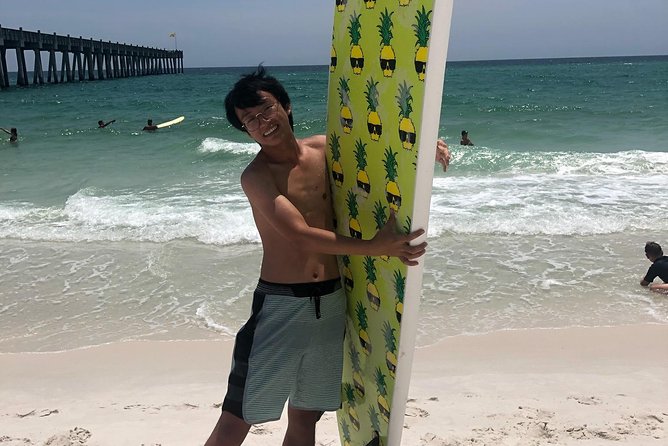
The maximum group size is 10. That is not a private lesson, but it is small enough to give the instructor a chance to work with individuals, especially during the water portion.
You will not receive uninterrupted one-to-one coaching. The instructor must divide time among everyone in the group, and the pace may be shaped by the least experienced person or by changing conditions. Even so, a group of 10 is more manageable than a large beach class where you only hear general instructions.
The most useful attention comes when you are trying to catch a wave. A quick correction about where to place your hands or when to stand can save several failed attempts. Help with line-up placement is also easier when the instructor can see the whole group.
If you are booking for a family, this setup can work well. The lesson is open to all ages, and the activity is designed for beginners rather than for people who already know how to surf. Keep in mind that children still need to meet the physical demands of the class, and the provided information does not give a specific minimum age.
What the $100 price really covers
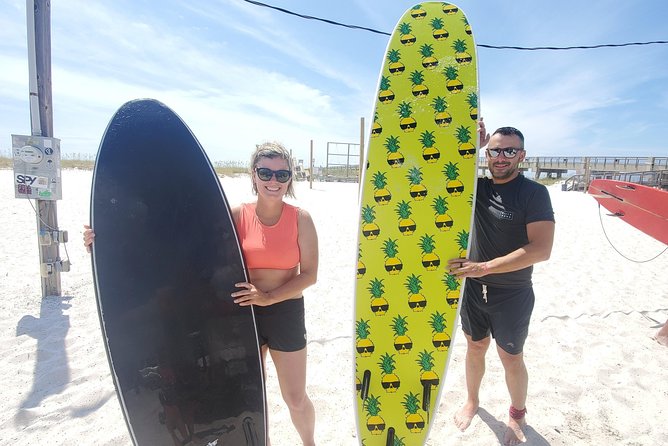
The cost is $100 per person. For that price, you receive the lesson, surfboard use, bottled water, and the instructor’s guidance on the beach and in the water.
The board is the biggest practical saving. You do not have to rent one separately or decide which size to choose before arriving. For someone testing surfing for the first time, that makes the price easier to justify. You are paying for instruction and equipment together, not only for access to the water.
The session lasts about two hours, with roughly 1.5 hours of instruction and board rental identified in the details. That leaves a little flexibility for getting organized, moving between the shore class and the water, and handling the natural pauses of a beach lesson.
You must bring your own sunscreen and rash guard or wetsuit. Those exclusions matter more than they may seem. Florida sun can make a short water session feel long, and a rash guard can help protect your skin from the board. The activity does not state that wetsuits are needed or supplied, so ask about current conditions if you are unsure what clothing to use.
Bottled water is supplied, but you may still want to bring any extra personal items you need for a beach outing. Only the board and bottled water are specifically included.
Weather, conditions, and the limits of a beach lesson
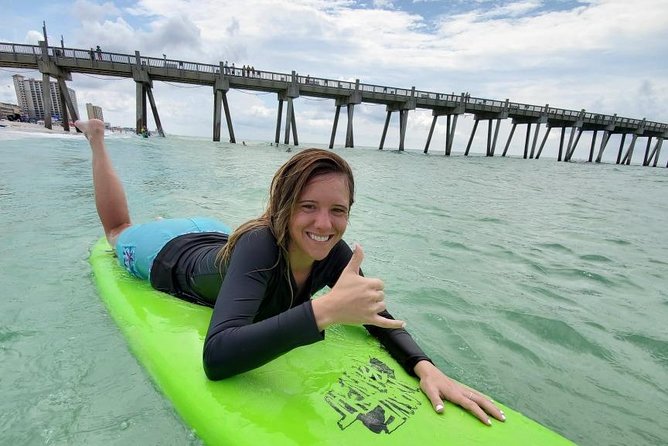
Surfing depends on nature. The provider may cancel if weather makes the experience unsuitable, in which case you are offered another date or a full refund. The same applies if the minimum number of participants is not reached.
A weather cancellation is not necessarily a flaw in this type of activity. It is safer and more useful to postpone than to force a beginner lesson in poor conditions. The tradeoff is that a surf lesson can be harder to fit into a tightly scheduled vacation.
Even on a day when the lesson runs, conditions may change the experience. The instructor controls how much time goes into paddling out and may alter the water portion based on what is safe and workable. You should arrive ready for a lesson shaped by the sea, not a fixed performance with guaranteed waves.
The free cancellation policy allows you to cancel up to 24 hours before the start time for a full refund. Cancellations or changes made less than 24 hours ahead are not refunded or accepted under the stated rules. The cut-off uses local time, so check the clock in Florida rather than relying on your home time zone.
Who will get the most from this experience
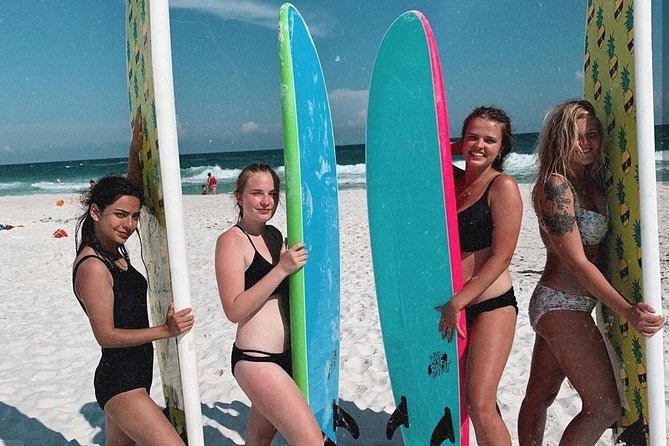
This lesson suits a first-time surfer who wants a guided introduction rather than a board rental with no help. It also fits families and groups with mixed levels, since all ages are welcome and the instructor can assist with individual positioning.
It is a good pick if you want to learn the building blocks of surfing during a Florida visit. You will get a taste of the sport, practice the key movements, and find out how your body handles paddling and standing on a board.
It may be less suitable if you want advanced coaching, a private instructor, or a long session focused only on surfing. The group can include up to 10 people, and the available information describes a beginner lesson rather than a progression course.
Your expectations matter. A successful first lesson does not require standing on every wave. You may spend a fair amount of time practicing, falling, resetting, and trying again. The value is in learning how to handle the board and the water safely, with a chance to catch some waves under supervision.
Should you book the Navarre Beach surf lesson?
Book it if you want a practical first taste of surfing and value having the board, basic safety instruction, and in-water help bundled into one $100 session. The small group, all-ages policy, and instructor support make it a sensible choice for families and complete beginners.
Think twice if your schedule cannot absorb a weather change, if you need private coaching, or if you do not want to bring your own sun protection and water clothing. Also confirm the meeting instructions before leaving, given the past communication problem connected with one booking.
For most beginners with moderate fitness, this is a straightforward way to try surfing at Navarre Beach without buying equipment or figuring out the water alone. Go in expecting practice rather than instant mastery, and the lesson offers a fair introduction to a new sport.
FAQ
Where does the surf lesson meet?
The lesson meets at the Navarre Beach Fishing Pier, 8579 Gulf Boulevard, Navarre, Florida 32566.
Where does the activity end?
The activity ends back at the Navarre Beach Fishing Pier meeting point.
How long does the surf lesson last?
The experience lasts approximately two hours. About 1.5 hours are devoted to instruction and board rental.
Is a surfboard included?
Yes. A surfboard is included in the experience.
Is bottled water included?
Yes. Bottled water is provided.
Do I need to bring a rash guard or wetsuit?
Yes. A rash guard or wetsuit is not included, so you need to arrange your own if you want one.
Is sunscreen provided?
No. Sunscreen is not included, so you should bring your own.
Is the lesson suitable for children and older beginners?
All ages are welcome. A moderate level of physical fitness is recommended.
What happens if the weather is poor?
If poor weather causes a cancellation, you will be offered a different date or a full refund. A full refund is also available if you cancel at least 24 hours before the start time.
Just added around the USA
- Surfing Lesson in Santa Barbara (2 Hours)★ 5.0 · 10 reviews
- Private Surf Lesson in Morro Bay★ 5.0 · 42 reviews
- Private Surf Lessons At Stinson Beach In Marin★ 5.0 · 2 reviews
- Beginner Surfing in San Francisco at Pacifica Beach★ 5.0 · 45 reviews
- Learn to Paddle Board on the San Francisco Bay!★ 5.0 · 4 reviews
- Private Surf Lesson★ 5.0 · 13 reviews
- Beginner Surf Lessons At Stinson Beach★ 5.0 · 5 reviews
- San Francisco Bay Kayak Or Paddle Board Tour★ 4.5 · 4 reviews
USA Surf Trips, compared.
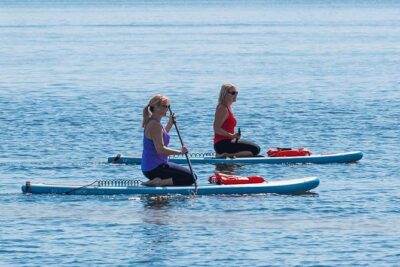
Dolphin and Manatee Stand Up Paddleboard Tour in Daytona Beach
Read our review →
Oahu North Shore Experience: Activities, Waterfall & Free Time
Read our review →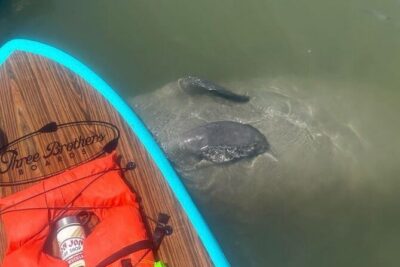
Dolphin, Manatee and SeaTurtle SUP Adventure Tour of St Augustine
Read our review →
Guided Island EcoTour: CLEAR/Standard Kayak, SUP – Bonita Springs
Read our review →
UTV Dune Cruise and Surf at Coral Pink Sand Dunes
Read our review →
Browse the lists this tour appears in