
Review · USA
Learn to Surf – Pensacola Beach
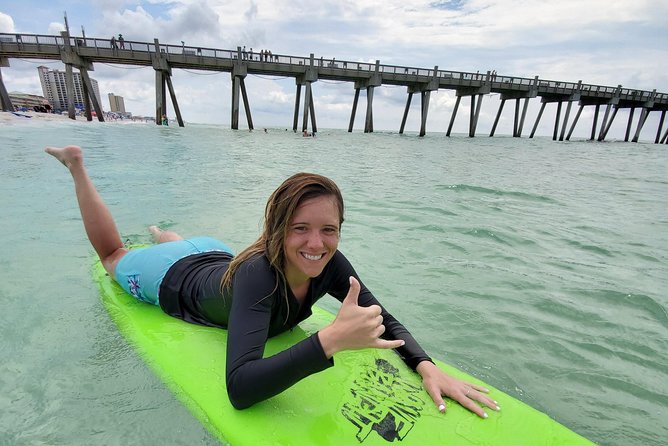
The best part of this Pensacola Beach lesson is that you are not left to figure out surfing alone. You begin on land, learn the pop-up and stance, then get direct help in the water, including a push into a wave if needed. The first successful stand can come after only a few tries, even for a complete beginner.
I like the small group limit of 10, since it gives the instructor time to watch your form and place you in the right part of the lineup. I also like that the lesson welcomes children and adults together. The main drawback is simple: surfing depends on weather and ocean conditions, and the included board and water do not cover sunscreen, a rash guard, or a wetsuit.
Key points before you book
- About two hours at Pensacola Beach: Plan on roughly 1.5 hours of instruction and board use, with the meeting point at Pensacola Beach Pier.
- A real beginner lesson: You work on prone position, paddling, the pop-up, stance, and basic ways to handle the board in the water.
- Small groups, with a maximum of 10 people: You should get more direct correction than in a large beach class.
- For children and adults: The lesson is designed for all ages, though a moderate level of physical fitness is expected.
- Patient instructors: Kai, Malachi, and AC are among the instructors named in the supplied feedback, with special praise for calm explanations and encouragement.
- Board included, personal sun gear not included: Bring sunscreen and plan your clothing before you arrive.
Starting at Pensacola Beach Pier
Your lesson begins at Pensacola Beach Pier, a practical meeting point that puts you close to the water from the start. The activity also finishes there, so you do not need to arrange a second pickup location or learn a new meeting point halfway through the morning or afternoon.
The scheduled operating window is 9:00 a.m. to 5:00 p.m., Monday through Sunday, during the listed season. Your exact booking time matters because the lesson is shaped by current sea conditions. Surfing is not like touring a museum, where the experience stays nearly the same all day. The instructor needs to judge the water before deciding how much time to spend on each skill.
The location is near public transportation, which helps if you are staying around Pensacola Beach and do not want to drive. The supplied information does not give parking details, so I would not build your plan around a particular parking arrangement. Give yourself enough time to reach the pier, find the meeting point, and get ready without rushing.
More Surf Lessons in the USA
- Maui: Two Hour Beginner Group Surf Lesson in Kihei
★ 5.0 · 950 reviews - Open Group Surfing Lesson in Waikiki, Hawaii
★ 4.5 · 582 reviews - Outrageous Surf ScHool Lesson on Lahaina Side
★ 4.5 · 547 reviews
The land lesson that makes the water time count
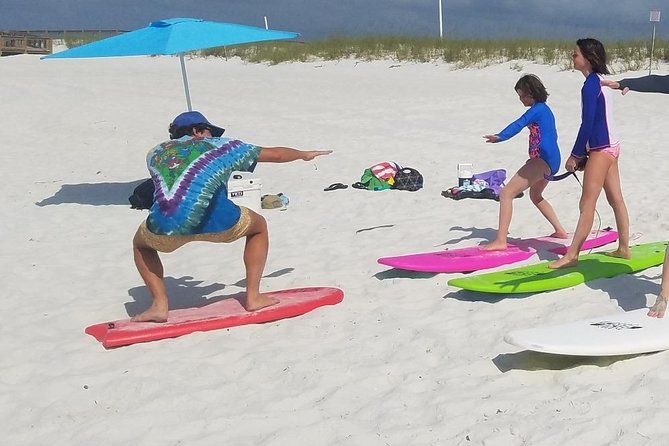
The first part of the class takes place on land. This is where the instructor explains the basics before you have to think about balance, paddling, waves, and the position of other surfers at the same time.
You will work on the proper prone position, which is how you lie on the board before standing. You will also practice paddling technique, the pop-up, and your stance. These steps may seem simple, but they are the part that makes a first surf session less confusing. If your feet land in the wrong place or you push up too slowly, the board will not feel stable. A clear land demonstration gives you something specific to repeat.
The pop-up is usually the moment beginners think about most. Here, you learn how to move from lying on the board to standing in one quick motion. The instructors also explain the proper stance, so you are not simply standing upright and hoping for the best.
This preparation is especially useful for families. A 13-year-old and a 40-year-old can learn the same basic movement, but they may need different pacing and reminders. The class format allows the instructor to show the group the main technique, then help individuals correct small problems.
A current conditions and marine life report
Before entering the water, the instructor gives a report on current conditions and marine life. That is a useful part of the lesson, not filler. The sea can change the best way to practice, and knowing what is around you helps you behave sensibly in the water.
The instructor also covers water safety and surf etiquette. For a first-time surfer, etiquette can be as important as balance. You need to understand how to share the water, where to position yourself, and how to avoid creating problems for other people.
The lesson does not promise identical instruction for every session. The amount of time spent explaining how to paddle out depends on the conditions. You might cover ducking under a wave, using a log roll, or handling a nose dive. The instructor chooses what makes sense for the water that day.
That flexible approach is a strength. It means the lesson is not just a fixed script repeated regardless of what the sea is doing. It also means you should expect the exact sequence to vary. You may spend more time on safety and paddling if the conditions call for it, and less time on a technique that is not useful that day.
Pensacola Beach practice in the water
Once you move into the water, the instructor helps each surfer find a suitable place in the lineup. For a beginner, this is a major benefit. Finding the right position on your own can be difficult because you are still learning to read waves while also trying to remember how to paddle and stand.
If you need help, the instructor can push you into a wave. That gives you a better chance to feel the board moving and attempt the pop-up without spending all your energy trying to catch the wave yourself.
The supplied feedback includes several first-time surfers who managed to stand after a handful of attempts. One beginner described getting up on the fifth attempt, while another said standing happened after a few tries. That does not mean every person will stand that quickly, and the school cannot control the sea or your balance. It does show what the lesson is built to do: give you enough instruction and practical help to make a first success possible.
You should still expect some misses. Falling is part of learning to surf, and a first lesson is not a guarantee that you will ride every wave. The more useful measure is whether you understand what went wrong and can try again with a better position or timing.
Same coast, a different way into the water:
- Dolphin and Manatee Stand Up Paddleboard Tour in Daytona Beach
★ 5.0 · 2,328 reviews - Oahu North Shore Experience: Activities, Waterfall & Free Time
★ 5.0 · 1,799 reviews - Raccoon Island: Exploration on SUP/Kayak
★ 4.8 · 1,289 reviews - Dolphin, Manatee and SeaTurtle SUP Adventure Tour of St Augustine
★ 5.0 · 1,219 reviews
Why the instructor matters here
A beginner surf class rises or falls on the quality of the instruction. The names associated with this experience include Kai, Malachi, and AC, along with Braden and AJ in the school’s broader customer contact. You may not be assigned one particular instructor, but the feedback gives you a sense of the teaching style to expect.
Kai is described as patient, kind, and attentive, including when helping a young participant. That matters if you are booking for a child or teenager who may need extra reassurance after a few falls.
Malachi is praised for giving clear instruction in a calm and comfortable way. That style suits beginners who do not want to feel pressured. AC is described as positive and encouraging while helping both a 40-year-old parent and a 13-year-old son get up on the board.
I would pay attention to that pattern if you are nervous about trying surfing. The class is not presented as a hard-charging athletic test. It is a lesson aimed at getting you comfortable, showing you the right movement, and helping you try again.
The value of a small group
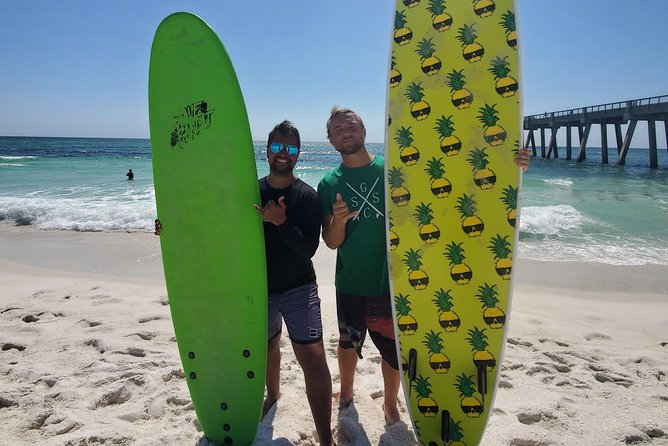
The maximum group size is 10 people. That is not a private lesson, but it is small enough to make a real difference compared with a large beach crowd.
You first receive shared instruction, so everyone learns the same safety points and basic movement. Once you are in the water, the instructor can watch several people while still giving individual help. You may receive a correction to your paddling, a reminder about your stance, or a push into a wave when the timing is right.
If you are booking for a family, the small group format also makes it easier to learn side by side. Adults and children can share the same lesson without needing separate activities. Keep in mind that everyone will have a different learning speed. One person may stand quickly, while another may still be working on the pop-up when the session ends.
The group size also has a practical limit. Ten people can still feel busy if everyone needs help at the same moment. The experience offers more attention than a large class, but it is not a one-to-one coaching session.
What to bring, and what the school supplies
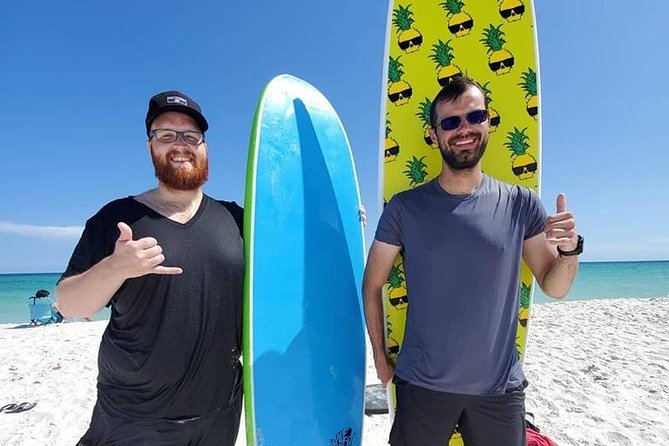
A surfboard and bottled water are included. That removes two basic concerns from your planning. You do not need to transport a board to Pensacola Beach, and you have water supplied during the lesson.
Sunscreen is not included, so bring your own. A rash guard or wetsuit is also not included. The supplied information does not specify which clothing is best for the conditions on your date, so ask the provider if you need help choosing what to wear.
A moderate physical fitness level is expected. You will stretch, lie on the board, paddle, push yourself up, stand, and get back on the board after falling. You do not need to arrive as an athlete, but you should be ready for active time in the water.
Arrive prepared for a physical lesson rather than a passive beach activity. Use sunscreen before the session, bring any personal items you need, and remember that the board rental is part of the instruction rather than a separate free-surf period.
A good choice for families and first-time surfers
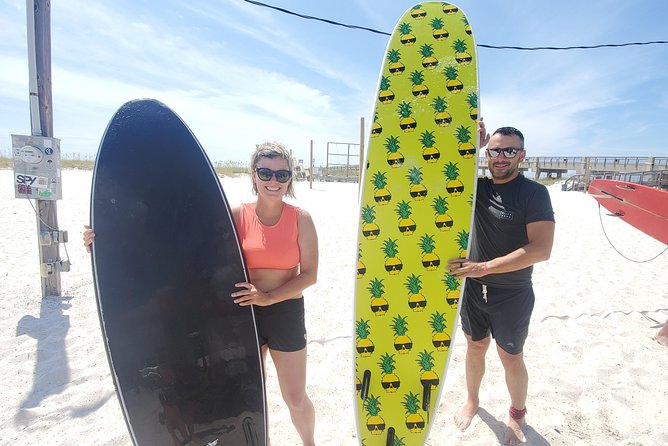
This lesson fits people who want to try surfing without committing to a longer course. The two-hour format gives you enough time to learn the basics and practice them, while still leaving part of the day open for other plans in Pensacola.
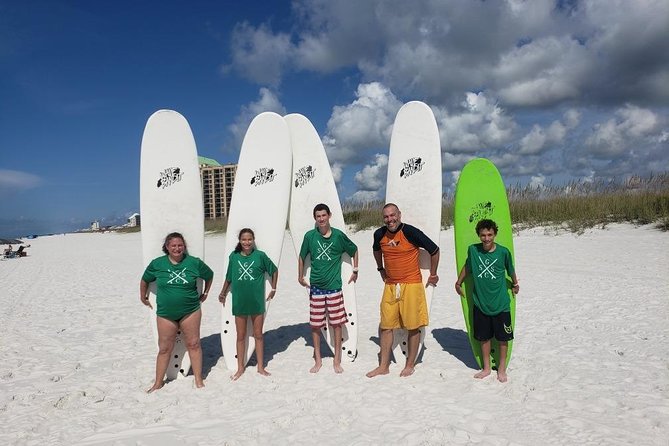
It also suits families with different ages. Children and adults are welcome, and the examples associated with the instruction include a parent and a 13-year-old learning together. The main question is not age alone, but comfort with moderate physical activity and time in the water.
You should choose this experience if your goal is to learn the fundamentals and perhaps stand on a wave for the first time. It is less suitable if you want advanced surf coaching, a long independent session, or a guaranteed number of waves. The lesson focuses on getting beginners safely started.
The positive teaching style may also help if you are hesitant. Several instructors are described as patient, easy to talk to, and encouraging. That is valuable in surfing because frustration arrives quickly when the board moves faster than your body expects.
Weather, cancellation, and planning risk
The lesson requires good weather. If poor weather causes a cancellation, you are offered a different date or a full refund. The experience also requires a minimum number of participants, so a cancellation for that reason comes with the same choice of another date or a full refund.
You can cancel for a full refund if you do so at least 24 hours before the start time. Cancellations or changes made less than 24 hours before the start time are not accepted for a refund. The cut-off uses local time in Pensacola.
This policy makes it wise to avoid placing the lesson at the very end of a tightly packed vacation schedule. Give yourself some flexibility, especially if catching a particular weather window matters to you. You do not control the surf conditions, so a backup plan is sensible.
Is the lesson worth booking?
The price is not provided here, so I cannot judge the exact cost. I can judge the value of what you receive: roughly two hours, board use, bottled water, safety instruction, land practice, guided water time, and help from an instructor in a group capped at 10.
That is a fair structure for a first attempt, especially because board rental and direct coaching are included. You are paying for more than access to the beach. You are paying for someone to teach the movement, explain how to share the water, place you in a workable position, and help you catch a wave if needed.
Book it if you want a friendly introduction and like the idea of learning by trying. Bring sunscreen, plan for active exercise, and accept that the sea may change the lesson. Skip it if you need a guaranteed calm day, private coaching, or a fully supplied clothing package.
For most first-time surfers in Pensacola, I would make this a strong candidate. The small group, practical land class, and patient teaching style give you a real chance to get standing on the board, while the short format keeps the commitment manageable.
FAQ
How long does the surf lesson last?
The experience lasts approximately two hours. A typical lesson includes about 1.5 hours of instruction and board rental.
Where does the lesson begin?
The meeting point is Pensacola Beach Pier in Pensacola Beach, Florida.
Where does the activity end?
The activity ends back at the meeting point at Pensacola Beach Pier.
Are children allowed to participate?
Yes. Children and adults of all ages are welcome.
What is included in the experience?
A surfboard and bottled water are included.
Is sunscreen provided?
No. Sunscreen is not included, so you should bring your own.
Are a rash guard or wetsuit provided?
No. A rash guard and wetsuit are not included.
How many people can join the lesson?
The activity has a maximum of 10 participants.
Is the lesson offered in English?
Yes. The experience is offered in English.
What happens if the weather is poor?
If poor weather causes the activity to be canceled, you are offered a different date or a full refund.
Just added around the USA
- Surfing Lesson in Santa Barbara (2 Hours)★ 5.0 · 10 reviews
- Private Surf Lesson in Morro Bay★ 5.0 · 42 reviews
- Private Surf Lessons At Stinson Beach In Marin★ 5.0 · 2 reviews
- Beginner Surfing in San Francisco at Pacifica Beach★ 5.0 · 45 reviews
- Learn to Paddle Board on the San Francisco Bay!★ 5.0 · 4 reviews
- Private Surf Lesson★ 5.0 · 13 reviews
- Beginner Surf Lessons At Stinson Beach★ 5.0 · 5 reviews
- San Francisco Bay Kayak Or Paddle Board Tour★ 4.5 · 4 reviews
USA Surf Trips, compared.
Dolphin and Manatee Stand Up Paddleboard Tour in Daytona Beach
Read our review →
Oahu North Shore Experience: Activities, Waterfall & Free Time
Read our review →
Dolphin, Manatee and SeaTurtle SUP Adventure Tour of St Augustine
Read our review →
Guided Island EcoTour: CLEAR/Standard Kayak, SUP – Bonita Springs
Read our review →
UTV Dune Cruise and Surf at Coral Pink Sand Dunes
Read our review →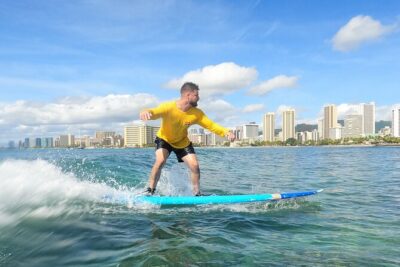
Browse the lists this tour appears in