
Review · OAHU
Hawaii: Electric Hydrofoil Surfing Solo Lesson
The remarkable part of this Hawaii lesson is that you can rise above the water on an electric hydrofoil board without knowing how to surf first. Your lesson moves in sensible steps: belly riding, knee riding, then a slow attempt at standing while the instructor keeps in touch through a radio helmet.
I like the balance-board simulator, which gives you a dry run at shifting your weight before the board is moving under you. I also like the patient progression, since you can take your time popping up instead of being expected to stand at once. The main consideration is the $299 price for 90 minutes, plus an extra $49 if you weigh 201 to 265 pounds.
Key points to know before booking
- Start on a balance-board eFoil simulator: Practice body position and center-of-gravity control on land before entering the water.
- Get 60 minutes of water time: The 90-minute session includes the land lesson, safety briefing, and on-water practice.
- Learn three riding positions: Begin belly down, move to your knees, then work toward standing.
- Use a Bluetooth remote: You control speed and practice turns, stops, and emergency procedures with instructor guidance.
- Stay in contact by radio helmet: The instructor can give you directions during the water portion.
- Check the weight and fitness rules: The standard limit is 200 pounds, with a $49 option for participants from 201 to 265 pounds.
Why this lesson is easier than it first looks
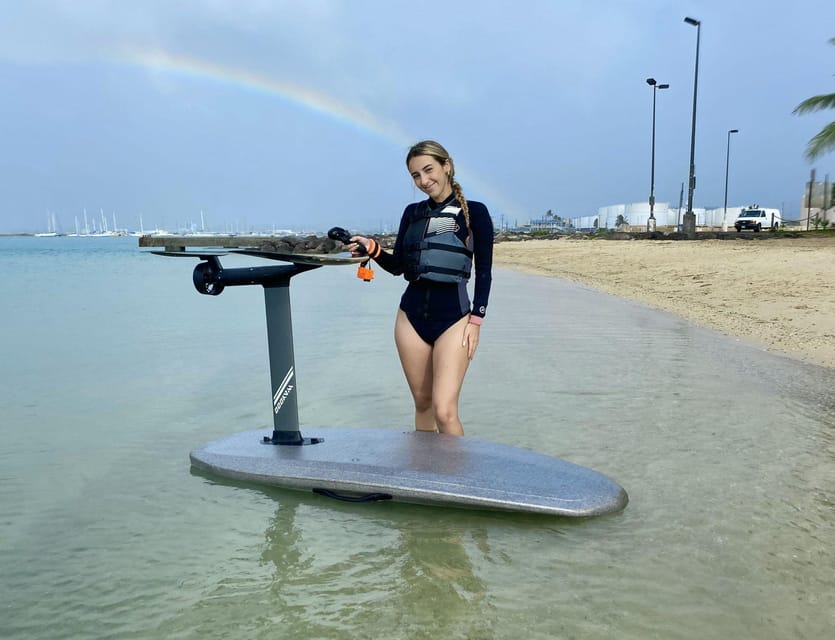
Electric hydrofoil surfing appears technical because the board eventually lifts above the water on a submerged wing. Yet you are not asked to master that motion immediately. The lesson breaks the skill into small actions that make sense: control the board while lying down, learn the remote, kneel and turn, then gradually shift your weight backward until the board begins to rise.
That order matters. A normal surf lesson asks you to read waves, paddle, catch a wave, and stand quickly. An eFoil lesson removes the need for waves, so you can focus on balance and control. You still need body awareness, but the electric motor provides forward motion.
The experience is set up as a private group, with instruction in English. The exact group size is not given, so ask when booking if you want to know how many people will share the lesson. A radio helmet is included, which is especially useful once you are moving away from the instructor on the water.
You do not need previous surf experience. You should be comfortable in the water while wearing a life jacket, and any background in board sports can help you progress faster. Skateboarding, wakeboarding, snowboarding, or similar activities may make the balance changes feel more familiar, but they are not required.
A few more sessions around Oahu worth a look
- Open Group Surfing Lesson in Waikiki, Hawaii
★ 4.5 · 582 reviews - Oahu: Beginner-Friendly Waikiki Beach Surfing Lesson
★ 4.9 · 425 reviews - Surfing Lessons On Waikiki Beach
★ 4.5 · 317 reviews
The first 30 minutes: simulator, safety, and control
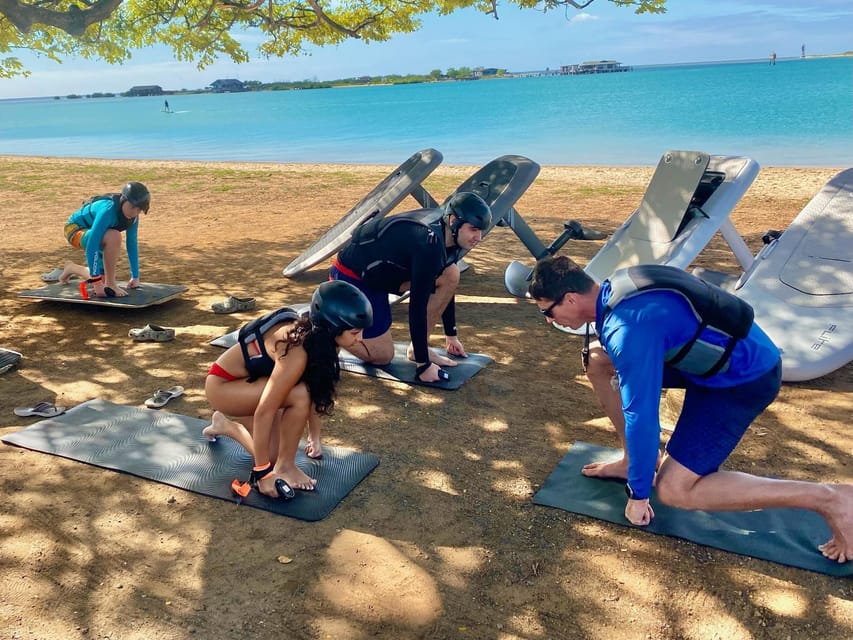
The session begins on land rather than with an immediate splash. You are fitted with a life jacket and whistle, then introduced to the equipment and the basic rules for falling away from the board.
The simulator is a balance board designed to copy some of the movements used on an eFoil. This is where you learn to control your center of gravity. Small weight shifts matter. Lean too far one way and the board responds; move too slowly and it may not change direction enough.
You practice the three main positions:
- Belly down: The simplest starting position and a stable way to learn the remote.
- Knee riding: A useful middle step that lets you turn and build confidence before standing.
- Standing: The final target, reached through a slow, controlled pop-up.
You also learn the Bluetooth remote. It controls the board’s motor, so you need to understand acceleration before you try to stand. The aim is not simply to go fast. It is to know how to slow down, stop, and keep the board manageable.
The safe-fall lesson deserves your full attention. If you lose balance, you are taught to fall away from the board rather than toward it. That is a basic point, but it is one of the most important parts of the session because the board has a motor and a foil beneath it.
By the time you enter the water, you have already covered the key controls. This makes the opening minutes on the board less confusing and gives you something useful to remember when your balance disappears.
The first water stage: belly rides and emergency stops
You receive 60 minutes of total water time. The first water exercises keep you close to the surface, beginning with belly rides.
This stage lets you feel how the board moves under power. You practice using the remote, making turns, and performing emergency stops. It may not look like the most dramatic part of the lesson, but it is where you learn the habits that keep the later standing attempts controlled.
Belly riding also gives you time to find the correct direction of travel. You can feel how the board responds when you adjust the remote and how much space you need to turn. Because you are not trying to balance upright yet, you can pay attention to the mechanics.
The radio helmet is a practical advantage here. The instructor can provide immediate instructions rather than waiting for you to return to shore or paddle back into position. If you are nervous about operating a powered board, that ongoing communication helps make the first stage less lonely.
At this point, you should not judge the lesson by how quickly you rise. A good early session is about learning control. The board needs to feel predictable before you add the harder task of standing.
Knee riding builds the bridge to eFoiling
Once belly rides and stopping feel manageable, the lesson moves to knee riding. This is the point where the experience begins to feel more like the real goal, since you can accelerate toward eFoiling speed and start making turns from a higher position.
Kneeling changes your balance. Your center of gravity rises, and the board responds more clearly to your body movement. You practice turns in both directions, which helps you find your proper stance.
Do not assume your preferred stance will be obvious at once. The instructor helps you work out which foot belongs forward and how to position your body on the board. Practicing both directions is valuable because it prevents you from learning only one comfortable turn.
The lesson’s pace is a strong feature. Unlike traditional surfing, you can take time before attempting to stand. You are not waiting for a wave that will disappear in seconds. The motor keeps the board moving, and the instructor can ask you to repeat a turn or stop before adding another task.
Knee riding is also the stage where you can start to feel the board’s lift. You are not yet fully above the water, but the speed and body position prepare you for the next step. If you have board-sport experience, this may be where you make quick progress. If not, repeating the basic turns is still useful.
Same coast, a different way into the water:
- Oahu North Shore Experience: Activities, Waterfall & Free Time
★ 5.0 · 1,799 reviews - Waikiki Private Group Surf Lesson
★ 5.0 · 298 reviews - Surf Lessons on the North Shore of Oahu
★ 5.0 · 267 reviews - Family, Private & Group Surfing Lessons, Waikiki Courtesy Shuttle
★ 5.0 · 216 reviews
The standing attempt: slow pop-ups and touch-and-go foil rides
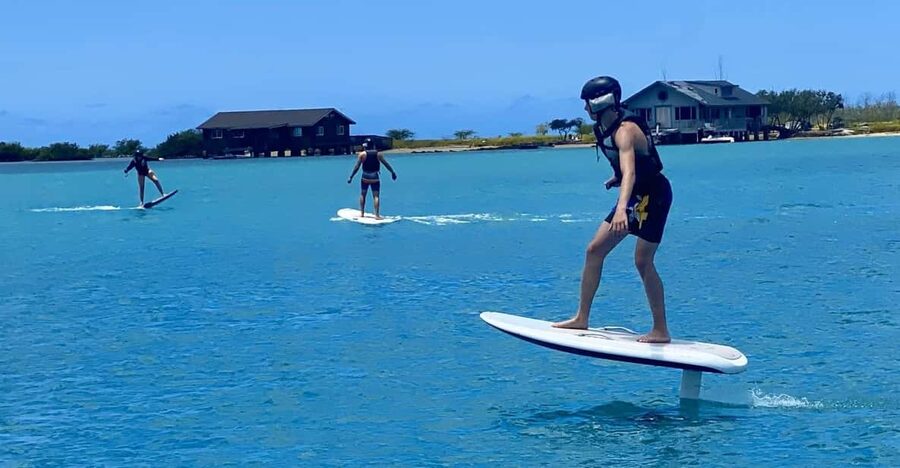
The move from knees to standing is handled as a slow pop-up. You are not expected to spring upright in one motion. Instead, you shift your weight carefully and use the position you practiced on the simulator.
The board may rise briefly, settle back down, and rise again. This touch-and-go style is part of the progression, not a sign that you have failed. You learn how much weight to place toward the back and how to keep your body centered as the board begins to lift.
When the board enters its eFoiling position, the sensation changes. The board is no longer riding entirely on the water, and small balance corrections become more important. The instructor’s radio guidance is useful here because you can receive a short correction while continuing to practice.
You work on turns in both directions from the standing position. That adds another layer of difficulty, so do not expect every attempt to be smooth. The lesson gives you time to repeat the movement and build a feel for the board.
The provider says all clients have managed to knee surf and stand during their first lesson, and that most students become confident eFoilers within 30 to 60 minutes of instruction. Treat that as a useful goal rather than a promise about your own pace. Your result will depend on comfort in the water, balance, and how quickly you adjust to the remote.
What the $299 price includes
The price is $299 per person. That is a significant cost for a 90-minute activity, but the package includes the specialized eFoil, safety equipment, land instruction, simulator practice, 60 minutes in the water, and an instructor using a radio helmet.
An eFoil is not ordinary beach equipment. You are paying for access to a powered hydrofoil board and for instruction that helps you use it safely. The land lesson adds value because you are not spending the entire session trying to understand the controls while already in the water.
The price makes the most sense if you want to learn a new skill rather than simply take a short ride. You receive a progression plan and repeated practice, not a quick demonstration followed by a return to shore.
The extra $49 charge applies to participants weighing 201 to 265 pounds. That brings the total to $348 per person before any other personal spending. The standard lesson limit is 200 pounds, so check this detail before booking rather than assuming the regular price applies.
Transportation to and from the activity is not included, and neither are food or drinks. You will need to arrange your own way to the location and bring the basics for a water activity.
Who will enjoy this most
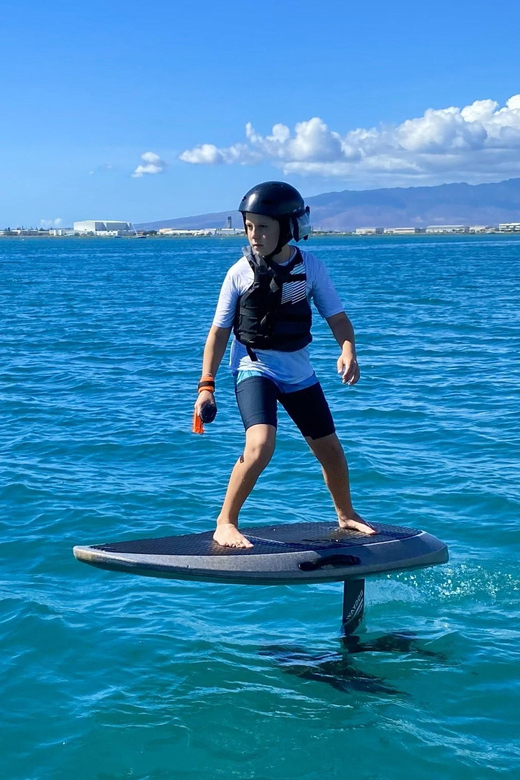
This lesson suits adults and children aged 10 or older who are comfortable in the water with a life jacket. You do not need surf experience, which makes it a good option if you want to try board riding but have never caught a wave.
It is especially suitable for people who like learning physical skills in stages. You will spend time on the simulator, repeat basic movements, and build toward standing. If you want instant speed with very little instruction, this may feel too methodical.
Board-sport experience can help you move from eSurfing to eFoiling faster. Still, the lesson is designed for different skill levels, so beginners are not expected to arrive with a particular stance or technique.
The experience is not suitable for pregnant women, people with back problems, or people with mobility impairments. You should also be comfortable in the water while wearing a life jacket. Those requirements matter because the lesson involves repeated changes in position and controlled falls.
Bring swimwear, sunscreen, and a hat. The equipment and safety gear are supplied, but personal sun protection is your responsibility.
Timing, cancellation, and planning details
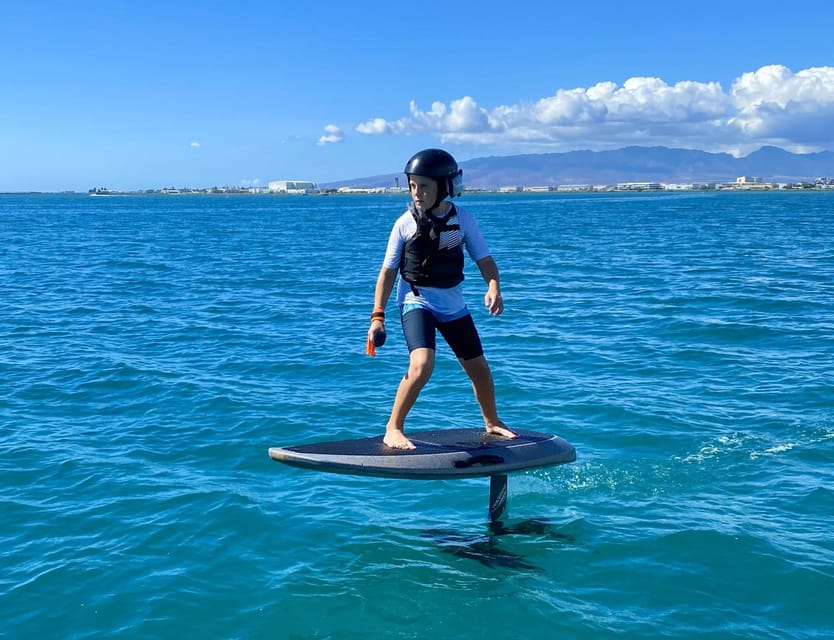
The full experience lasts 90 minutes, with 60 minutes on the water. The remaining time covers the land lesson, simulator work, safety information, and equipment preparation.
Starting times depend on availability. Since transportation is not provided, leave enough time to reach the activity location without rushing. Food and drinks are also excluded, so plan those separately.
The instructor speaks English. You receive a life jacket and whistle, and the radio helmet allows for constant communication during the lesson.
You can cancel up to 24 hours in advance for a full refund. A reserve-now-and-pay-later option is also available, which can help if you are still arranging your Hawaii plans.
Should you book this Hawaii eFoil lesson?
Book it if you want a hands-on introduction to electric hydrofoil surfing and value instruction more than a quick thrill. The simulator, staged practice, radio helmet, and full hour on the water give you a real chance to learn the skill rather than simply ride behind an instructor.
I would be more cautious if $299 feels high for a short activity, if you are not comfortable in the water, or if you have a back or mobility issue. Also check the weight surcharge before paying.
For a first eFoil lesson, the gradual route from belly riding to kneeling and standing is the strongest reason to choose this experience. You can take your time, practice turns in both directions, and learn how to control the board before trying to fly above the water.
FAQ
Do I need previous surfing experience?
No. Previous surf experience is not required. Experience with board sports may help you progress faster.
How long does the lesson last?
The lesson lasts 90 minutes in total, including 60 minutes of water time.
How much does the experience cost?
The listed price is $299 per person. Participants weighing 201 to 265 pounds pay an additional $49.
What weight limit applies?
The standard lesson has a limit of 200 pounds. An additional option is available for participants from 201 to 265 pounds at an extra cost.
How old must participants be?
Participants must be at least 10 years old.
What positions will I learn?
You practice riding belly down, riding on your knees, and standing on the eFoil.
Is safety equipment provided?
Yes. A life jacket and whistle are included. You also learn how to fall safely away from the board.
Can I communicate with the instructor while on the water?
Yes. A radio helmet is included for constant communication with the instructor.
What should I bring?
Bring a hat, swimwear, and sunscreen.
Can I cancel for a refund?
Yes. You can cancel up to 24 hours in advance for a full refund. You can also reserve now and pay later.
Just added around Oahu
- Surf Honolulu: Ala Moana Stand-up Paddleboard Lesson★ 5.0 · 3 reviews
- Semi-Private Surfing Lesson in Waikiki, Oahu★ 5.0 · 26 reviews
- Waikiki 2 Hours Private Guided Surf Lesson★ 3.5 · 8 reviews
- Surf Activity on the Wai Kai Wave in Ewa Beach★ 5.0 · 8 reviews
- Bodyboarding 1-to-1 Private Lesson with Waikiki Courtesy Shuttle★ 5.0 · 5 reviews
- Surf Lessons on the North Shore Great for Families and all Ages★ 5.0 · 27 reviews
- Stand Up Paddle Open Group Lesson with Waikiki Courtesy Shuttle★ 4.5 · 6 reviews
- Family Stand Up Paddle Lesson with Waikiki Courtesy Shuttle★ 5.0 · 3 reviews
Oahu Surf Trips, compared.
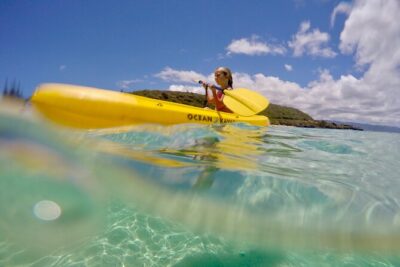
Oahu North Shore Experience: Activities, Waterfall & Free Time
Read our review →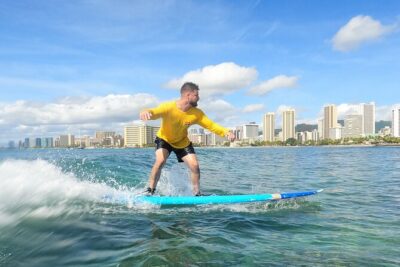
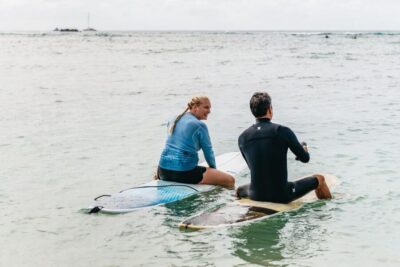
Beginner-Friendly Waikiki Beach Surfing Lesson
Read our review →
Family, Private & Group Surfing Lessons, Waikiki Courtesy Shuttle
Read our review →
Haleiwa River Paddle Board Rental with Blue Planet Adventure Co.
Read our review →Browse the lists this tour appears in