
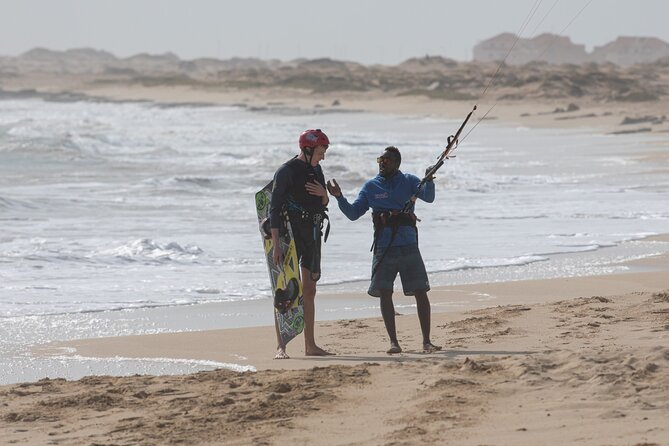
Review · KITESURFING LESSONS
Kitesurf Lessons in Cape Verde
Kite Beach gives this short lesson a clear purpose: you are not just watching Cape Verde’s famous wind sport, you are learning the basic skills that make it work. The session moves from a small trainer kite on the sand to a full-size kite, safety practice, and supervised body dragging in the water.
I like the IKO-qualified instructors and the tidy progression from simple kite control to water practice. I also like that this is a private activity for your group, with instructors able to keep the lesson focused. The main drawback is time: two hours is enough for a first taste, but not enough to make you independent on the kite.
Key points for your first kite lesson
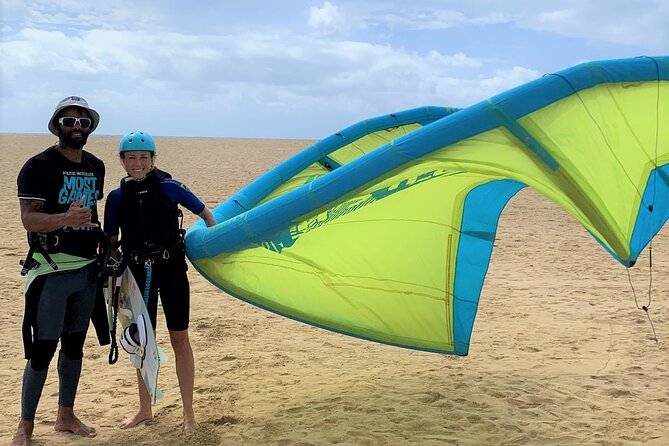
- Start with a small trainer kite: Learn steering and basic kite control on the beach before handling larger equipment.
- Practice safety before entering the water: The full-size kite session includes the safety systems and skills you need to understand first.
- Finish with body dragging: You’ll use the kite in the water while the instructor guides you through the first real feel of kitesurfing.
- Meet at Surf Hub Cabo Verde: The shop is on Rua 15 de Agosto in Santa Maria, and the activity returns there afterward.
- Private instruction matters: Only your group takes part, so the lesson can match your pace and previous experience.
- Plan for a physical session: You must be able to swim and have a moderate level of fitness.
From Santa Maria to Kite Beach

Your lesson begins at Surf Hub Cabo Verde on Rua 15 de Agosto in Santa Maria. That shop meeting point keeps the start simple. You arrive, prepare your equipment, and get set for the trip to Kite Beach rather than trying to find the lesson location on your own.
The move from town to the beach is useful because the lesson takes place where the sport actually works. Kite Beach is the setting for the practical part of the session, with room for beach instruction and access to the water. The exact transport arrangement should be confirmed when you book, but the stated plan is to prepare at the shop and then take you to the beach.
The opening hours are Monday through Saturday, 9:00 a.m. to 4:30 p.m. That gives you a daytime window, but it also means you should check the chosen start time carefully. Kitesurfing depends on wind and weather, so flexibility is sensible.
More Kitesurfing Lessons in the world:
- Private Kitesurf Lesson in Lo Stagnone Sicily
★ 5.0 · 101 reviews - KiteSurfing or Surfing Experience in Essaouira
★ 5.0 · 91 reviews - Kitesurf – Advanced course with individual lessons
★ 5.0 · 88 reviews
The first 20 minutes with a trainer kite
The lesson begins on land with a small training kite. This is the right place to start. Before you worry about standing on a board, you need to understand how the kite responds to your hands, the wind, and small changes in direction.
You’ll work on basic kiteflying skills with the instructor close by. The small kite is easier to manage than the full-size equipment, so mistakes are less intimidating. I like this part because it gives you a way to learn the sport’s central idea: the kite is powered by the wind, and your job is to control that power rather than fight it.
For a complete beginner, this beach stage is valuable even if it feels less exciting than getting wet. It builds the hand control that you will need later. You should expect to spend real time listening, watching, and repeating movements. A two-hour lesson moves quickly, so the goal is not to master every trick. It is to understand the basics well enough to continue safely.
If you have already flown a trainer kite, the instructor may be able to move faster. The private format helps here. You are not waiting for a large class to catch up, and the instructor can give more attention to your particular control problems.
Handling the full-size kite safely
Once you have the basic kite skills, you move to the larger kite. This is where the session begins to feel more like real kitesurfing. The larger equipment responds with more power, so safety becomes a central part of the lesson rather than a quick briefing.
You’ll learn the safety systems and the skills needed to manage the kite. That instruction is especially important for first-timers. The excitement of a kite pulling against the wind is also the main reason you need to know how to reduce that power when required.
The quality of an introduction is not measured only by how quickly you get into the water. It is also measured by how clearly the instructor explains what to do when the kite behaves differently from what you expect. The school is registered with IKO, and its instructors are IKO qualified. That gives the lesson a formal instructional framework, though your progress will still depend on wind conditions, your comfort level, and how quickly you pick up the controls.
Be ready for a session that asks for concentration. You may be standing on the sand, but controlling a kite is active work. Moderate fitness is required, and the school specifically says you must be able to swim.
Body dragging in the water
The final stage takes you into the water with the instructor for body dragging. This is the moment when the beach exercises connect with the real sport. You use the kite’s pull to move through the water without beginning with a board.
Body dragging is a sensible first water skill because it lets you feel the kite’s power while keeping the equipment focus on kite control. You will not simply be sent out alone. The instructor stays involved and guides you through the exercise.
For many people, this will be the most memorable part of the two hours. The water changes the feel of the kite, and you begin to understand how wind direction, body position, and steering work together. It can also be tiring. Swimming ability is not an optional extra here, and you should expect to work with the water rather than passively float in it.
The experience does not promise that you will ride a board, go upwind, or complete transitions during this introductory session. Those are later goals. The stated finish is supervised body dragging, which is a realistic and useful first step.
A few more sessions around the world worth a look
- Ibiza: Beach Hopping Cruise w/ Paddleboard, Food, & Drinks
★ 4.5 · 3,224 reviews - Dolphin and Manatee Stand Up Paddleboard Tour in Daytona Beach
★ 5.0 · 2,328 reviews - Magnetic Island Discovery Tour with Snorkeling & Paddle Boarding
★ 5.0 · 1,372 reviews - Tenerife: Surfing Lesson for All Levels, Photos included
★ 4.9 · 1,314 reviews
What the private format changes
This is a private activity, meaning only your group takes part. That can make a noticeable difference in a sport where each person may learn at a different speed.
You can ask the instructor to repeat a safety step, spend longer on kite control, or move ahead if the basics come naturally. A private lesson also reduces the chance that you spend much of the session watching another beginner handle the kite.
The tradeoff is that a two-hour private lesson remains an introduction, not a full course. If your group includes people with very different abilities, the instructor will need to balance those needs. A private booking gives you flexibility, but it does not remove the limits of time and weather.
The school has also arranged broader water-sport programs for some visitors, including combinations of kitesurfing, surfing, sailing, and yoga. You do not need to book a larger package to take this lesson, but it is useful to know that the school can be part of a longer Sal stay if you want more than one session.
The instructors and teaching style
All instructors are IKO qualified, and the school is registered with IKO. That is the clearest formal detail available about the teaching team. The instruction includes kite control, equipment handling, safety systems, and water practice, rather than only a short demonstration.
Amy is the person associated with arranging lessons and wider holiday plans through Surf Hub Cabo Verde. Tchu is also named in connection with the school’s kite instruction. If you have a preferred instructor or need help planning several activities, ask about availability when booking rather than assuming a specific instructor will lead your session.
The teaching approach appears suited to beginners because it starts with the smallest, simplest tool and builds upward. Patience matters in kitesurfing. You may understand the explanation on land but need several attempts before your hands make the right correction automatically.
I would judge the lesson by how well you understand the kite and safety systems at the end, not only by how dramatic the water portion feels. A calm, clear explanation is more useful than being pushed into an activity before you are ready.
Is $141.14 good value for two hours?
At $141.14 per person, this is not a cheap beach activity. The value depends on what you want from the session. You are paying for private instruction, equipment preparation, IKO-qualified teaching, beach practice, full-size kite work, safety training, and water instruction.
That price makes more sense if you want a proper first lesson rather than a brief novelty experience. The school provides the equipment used during the session, and the structure is designed to give you a base for future lessons. If you only want to hold a kite for a few minutes, this will feel expensive. If you want a serious introduction to a sport associated with Sal, the focused format is easier to justify.
The private setup is the strongest value point. A large group lesson might cost less per person, but you could receive less direct time with the instructor. Here, your group gets the full session, subject to weather and the pace of the people booked together.
You should also consider the cost of what the lesson does not include in the stated details. There is no promise here of board riding, independent kitesurfing, hotel pickup, or a full day on the water. Treat it as a first lesson, not as a complete certification course.
What to bring and how to prepare
The school prepares the equipment, but you still need to arrive ready for an active beach and water session. Wear clothing suitable for movement and water, and bring anything you normally need for sun protection. The supplied information does not specify a packing list, so confirm equipment and clothing details with the school before you go.
You must be able to swim. That requirement matters because the final part takes place in the water, and the lesson uses the kite’s pull while you are body dragging. You should also be comfortable with moderate physical activity.
Allow enough time to reach the shop before the lesson. The activity starts there, not directly at Kite Beach. After the session, it ends back at the meeting point, so you have a clear beginning and end in Santa Maria.
Keep your schedule flexible. The activity requires good weather, and poor conditions can lead to a different date or a full refund. Wind is central to kitesurfing, so a weather change is not a minor inconvenience. It affects whether the lesson can be run safely and properly.
Who should book this lesson?
This suits you if you are curious about kitesurfing but have never handled a kite. It also works for a mixed group that includes complete beginners and people with a little previous practice, since private instruction can be adjusted.
It is a good fit for an active Sal holiday. You can make the lesson one part of a broader plan that includes surfing, sailing, yoga, or island activities. The school has experience helping visitors organize several activities, though this particular booking remains a focused two-hour session.
It may not suit you if you want to ride a board immediately, dislike water-based exercise, or cannot swim. It is also a poor choice if your schedule is so tight that a weather change would ruin your plans.
Families can consider it, but every participant must meet the swimming and fitness requirements. Children’s ages and any age limits are not provided, so ask the school directly before booking for a young participant.
Booking, cancellation, and weather details
You receive confirmation at the time of booking, and the activity accepts mobile tickets. Service animals are allowed. The experience is offered Monday through Saturday, from 9:00 a.m. to 4:30 p.m.
You can cancel up to 24 hours before the start time for a full refund. Cancellations or changes made less than 24 hours before the local start time are not accepted for a refund.
If poor weather forces the school to cancel, you are offered a different date or a full refund. That policy is important for a wind sport, so I would avoid placing this lesson on the final day of your holiday if you have room to schedule it earlier.
Should you book the Surf Hub Cabo Verde lesson?
Book it if you want a structured first encounter with kitesurfing in Sal, especially if private instruction and safety training matter to you. The progression from trainer kite to full-size kite to body dragging makes good sense, and the IKO-qualified teaching team adds useful reassurance.
Do not book it expecting to become an independent rider in two hours. You may finish with a strong first feel for the sport, but board riding and more advanced skills require further instruction and practice.
For a first taste, the price is reasonable when you value direct attention and included equipment. Choose an earlier day in your stay, confirm the meeting details and instructor availability, and arrive ready to swim, listen, and work. That gives you the best chance of turning a short lesson into the start of a new sport.
FAQ
Where does the kitesurf lesson start?
The lesson starts at Surf Hub Cabo Verde on Rua 15 de Agosto in Santa Maria, Sal, Cape Verde.
Where does the activity finish?
The activity finishes back at the meeting point in Santa Maria.
How long does the lesson last?
The lesson lasts approximately two hours.
Do I need to know how to kitesurf already?
No previous kitesurfing experience is stated as a requirement. The session is designed as a first taste, beginning with a small training kite and progressing to a full-size kite and water practice.
Do I need to be able to swim?
Yes. Participants must be able to swim and have a moderate level of physical fitness.
What happens if the weather is poor?
If the activity is canceled because of poor weather, you are offered a different date or a full refund. You can also cancel up to 24 hours before the start time for a full refund.
Just added around the world
- Surfing Lesson in Santa Barbara (2 Hours)★ 5.0 · 10 reviews
- Private Windsurf Experience in Puerto Rico★ 5.0 · 7 reviews
- San Juan Surfing Lessons: Ride the Waves in Puerto Rico★ 5.0 · 30 reviews
- Sunrise SUP tour & breakfast – Private stand up paddle boarding experience★ 5.0 · 20 reviews
- Surf the Basque Country Day trip – Private experience★ 5.0 · 5 reviews
- Private Surf Lesson in Morro Bay★ 5.0 · 42 reviews
- San Juan | Paddleboard | Kayak | Snorkeling | Guided Tours★ 4.5 · 4 reviews
- 120 Min Surf Lesson / Great for All Levels★ 5.0 · 8 reviews
Kitesurfing Lessons, compared.
Semi-private kitesurfing lessons in Tarifa (adapted to every level)
Read our review →
Group Kitesurfing lesson with a Local in Essaouira Morocco
Read our review →
Browse the lists this tour appears in