
Review · MAUI
Maui Small-Group Kiteboarding Lesson – Kite Beach
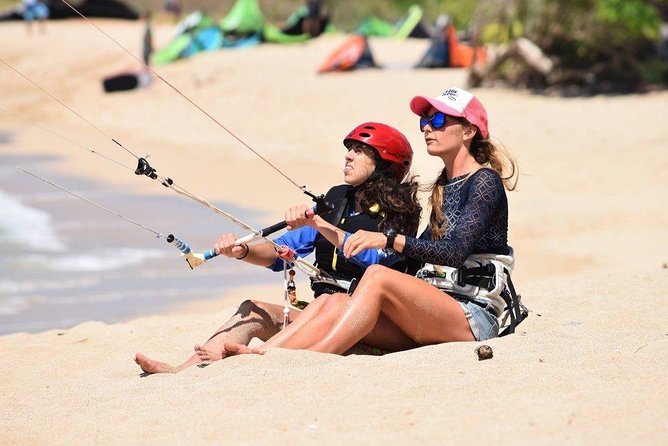
Kiteboarding looks wild from shore, but this small-group lesson breaks it into clear steps: choose your gear, learn kite control on the sand, practice in the water with an instructor, then test your skills on your own. It is built for beginners, so you do not need to arrive with board time or kite experience.
I like the practical focus and the patient teaching style. Troy helped one first-timer understand kite flying beyond what online videos had explained, while Mikalea earned praise for staying calm and patient through a tricky learning curve. I also like that your lesson is adjusted to your skill level.
The catch is physical: you need to be able to swim and have a moderate fitness level. At $295 per person, this is not a casual beach activity, and wind or weather can affect the day.
Key points at a glance
- Start with gear and beach basics: You choose equipment, learn the Kite Beach setup, and get a safety-minded introduction before entering the water.
- Practice in three stages: The lesson moves from ground school, to guided water exercises, to solo practice.
- No prior experience required: The teaching is designed for beginners, including people who have only watched videos or handled gear at home.
- Instruction stays personal: The group is capped at 10 people, with the lesson adjusted to each person’s ability.
- Swimming is required: You must be able to swim, and a moderate level of fitness is expected.
- Weather matters: Poor conditions can lead to a new date or a full refund.
What the $295 Maui kiteboarding lesson is really buying
The price is $295 per person for about two and a half hours. That puts this firmly in the special-activity category, not the inexpensive add-on category. You are paying for professional instruction, equipment use implied by the lesson format, bottled water, tax, and a guided progression from shore to water.
The value depends on your goal. If you simply want to watch kiteboarders from the beach, this costs far too much. If you want a real introduction to kiteboarding and hope to continue at home, the price makes more sense because an instructor can correct mistakes before they become habits.
The experience is also more useful than a quick ride where someone does everything for you. You are expected to learn the basic skills needed to become a kiteboarding partner. That means the lesson has an educational purpose, not just a thrill-ride purpose.
Still, two and a half hours is only a first lesson. Do not book this expecting to master kiteboarding in one morning or afternoon. The best result is a solid start, a clearer sense of the sport, and enough practice to decide if you want more training.
More Kitesurfing Lessons in Maui:
- 2.5-Hour Private Kiteboarding Lessons at Kanaha Beach in Kahului
★ 5.0 · 6 reviews - Semi-private kitesurfing lessons in Tarifa (adapted to every level)
★ 5.0 · 214 reviews - Kitesurfing Lessons in Essaouira Beach
★ 5.0 · 206 reviews
Starting at Action Sports Maui in Kihei
Your listed meeting point is Action Sports Maui at Kalama Beach Park in Kihei, Hawaii. The activity ends back at the meeting point. Transportation to or from attractions is not included, so you need to arrange your own way there and back.
The information for the experience also places the lesson around Kahului Harbor and Kite Beach. Since the meeting point and lesson area are described separately, check the exact meeting instructions before setting out. Do not assume your hotel, rental car, or another Maui attraction is close by.
The mobile ticket is useful for a day when you may already be moving around the island. Keep your confirmation easy to access, and allow enough time to find the meeting point without rushing into a water sport.
At booking, you must provide the weight of every participant. This is not a minor form detail. Kite size and equipment setup depend on the person using them, so accurate information helps the instructor prepare suitable gear.
Choosing gear before you touch the water
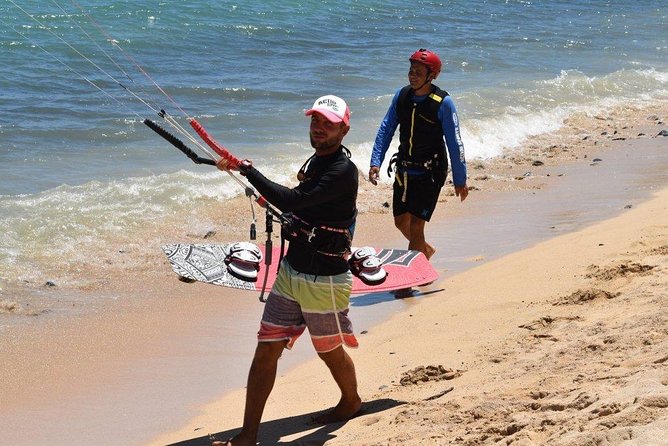
The lesson begins with gear selection. That gives you a chance to see the equipment before you are asked to control it. A good first lesson should make the gear feel understandable rather than mysterious, and this opening stage sets that tone.
You also get an orientation to Kite Beach. The purpose is to help you understand where the lesson takes place and how the beach portion fits with the water work. The supplied details do not promise a sightseeing stop or a long beach talk, so think of this as useful preparation rather than a separate attraction.
The gear stage may be especially helpful if you have watched kiteboarding videos or bought equipment before taking lessons. One participant arrived with some equipment at home and plenty of video knowledge, but still needed instruction to connect theory with real kite control. That is a useful warning: watching tutorials can give you vocabulary, but it does not replace hands-on coaching.
Ground school: learning control on the beach
Before you enter the water, you work through ground school on the beach. This is where the instructor introduces the basic skills required for kite control and explains how the lesson will progress.
For a beginner, this step matters. Kiteboarding combines wind, equipment, body position, and timing. Trying to sort those pieces out in the water all at once would be a poor first lesson. Starting on land lets you focus on the kite and the instructions without adding water movement to the problem.
The exact drills may vary with your skill level. The experience is tailored to the student, so someone who already understands basic kite handling may move through the first section differently from someone who has never touched the equipment.
I would pay close attention here, even if you think you know the basics. Troy’s teaching helped one beginner notice practical points that online videos had missed. That is the value of an instructor in person: small corrections can make the next stage safer and easier to understand.
Same coast, a different way into the water:
- Maui: Two Hour Beginner Group Surf Lesson in Kihei
★ 5.0 · 950 reviews - Outrageous Surf ScHool Lesson on Lahaina Side
★ 4.5 · 547 reviews - Private Stand Up Paddle Boarding Tour in Turtle Town, Maui
★ 5.0 · 293 reviews - Group Surf Lesson at Kalama Beach in Kihei
★ 5.0 · 264 reviews
Guided water practice at Kahului Harbor
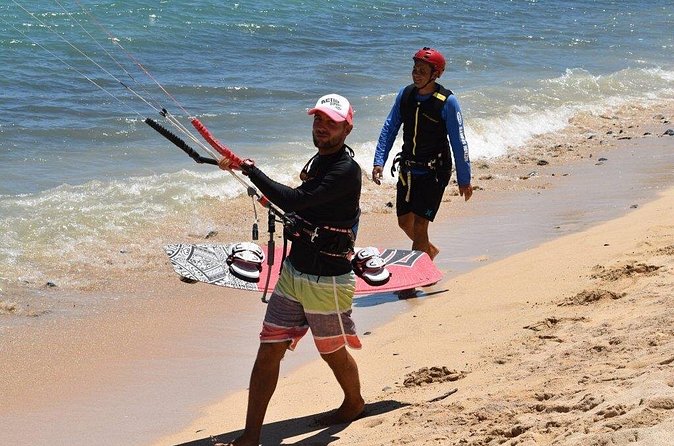
The next phase moves into the water, with the instructor accompanying you during training exercises. This is where the lesson becomes physical and more demanding.
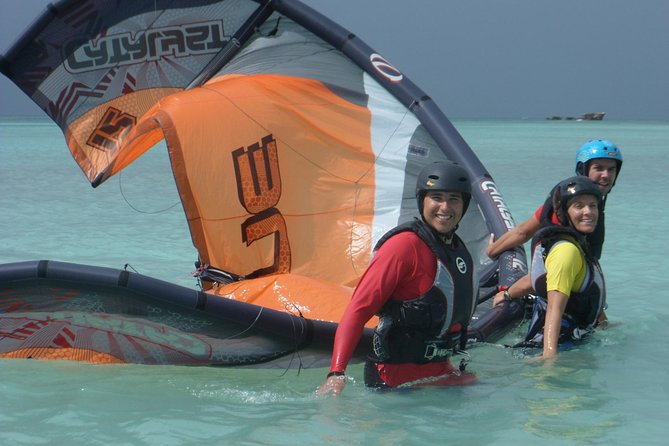
The water work includes practicing the skills introduced on the beach, along with the sensation of being pulled and moving through the water. One participant specifically enjoyed the experience of dragging in the water and learning the launch. Those moments can be exciting, but they also require attention and a willingness to follow directions closely.
You should expect effort rather than a relaxed swim. The activity requires a moderate fitness level, and all participants must be able to swim. The swimming requirement is especially important because the lesson takes place in the water and includes controlled movement with kite power.
Your instructor remains part of this stage, which gives you help while you work out the basic motions. For a first-timer, that support is one of the strongest reasons to choose a lesson instead of trying to learn alone.
The solo practice stage
After guided water drills, the lesson moves toward practicing on your own. This does not mean you suddenly become an expert or are left to figure out everything without help. It means you get a chance to apply what you have learned with more independence.
That final stage is important because kiteboarding requires you to connect several actions at once. You need to recall the beach instructions, manage the equipment, respond to the water, and make adjustments as conditions change.
The format also gives you a better test of whether kiteboarding suits you. You will feel the difference between simply copying an instructor and handling the process yourself. Some people will find that moment rewarding. Others may discover that the sport demands more strength, patience, or coordination than expected.
Mikalea’s teaching style is worth noting here. The lesson is not described as effortless, and the sport can take time to pick up. Her patience and professional approach helped make a difficult activity feel manageable. That combination matters more than a flashy teaching style during a first water session.
How the small-group format affects your lesson
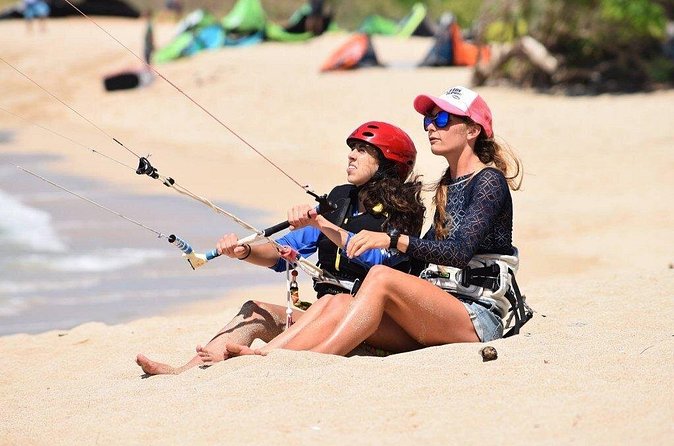
The activity allows a maximum of 10 participants. That is still a group rather than a private lesson, so you should not expect constant one-to-one attention. Your time may be shared with other people at different skill levels.
The benefit is that the lesson remains more personal than a large class. The instructor can tailor the teaching to ability, and the progression from beach to water to solo practice gives the group a clear structure.
Your experience may also depend on how many people attend that day. A group of only a few participants could feel more individual. A full group of 10 may mean more waiting or less direct practice time. The supplied details do not promise a specific instructor-to-participant ratio, so I would keep expectations sensible.
The shared format works best if you are comfortable learning alongside others. It may suit couples, friends, or individuals who want professional guidance without paying for a private session.
The instructors and the kind of teaching to expect
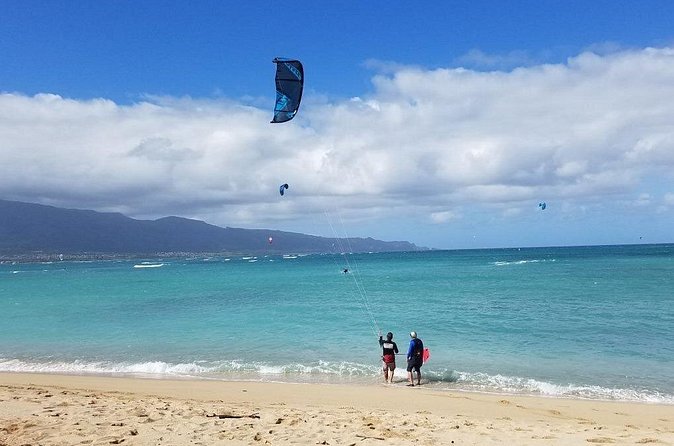
Two instructors are singled out in the experience feedback: Troy and Mikalea. Troy helped a beginner move past the limits of online videos, adding practical pointers during kite flying, water dragging, and the launch. That suggests an emphasis on useful corrections rather than theory alone.
Mikalea was praised for being professional and patient from start to finish. That is a meaningful quality here because kiteboarding is not an instant skill. A calm instructor can keep a difficult moment from turning into frustration.
You should still understand that instructors are not promising to make the sport easy. Their job is to give you the right steps, adjust the lesson to your ability, and help you practice. Your progress will depend on your fitness, coordination, comfort in the water, and ability to follow directions.
The experience has a perfect rating from four reviews, but the sample is small. I would treat that as encouraging evidence about the instructors, not proof that every participant will have the same result.
What to bring and what is not included
Bottled water, tax, and a professional guide are included. Food and other drinks are not included, so plan those separately if you need more than water.
Transportation is also not included. You must get to Action Sports Maui at Kalama Beach Park on your own, and the activity returns to the meeting point at the end.
The practical requirements are clear:
- Give the weight of every participant when booking.
- Make sure every participant can swim.
- Expect moderate physical activity.
- Bring a sense of adventure and patience.
- Keep the mobile confirmation available.
The information does not provide a specific packing list, clothing rule, age requirement, or detailed equipment list. I would avoid assuming that an ordinary sightseeing outfit will be suitable for a water lesson. Confirm any clothing and personal-item questions with Action Sports Maui before the activity.
Weather, timing, and cancellation rules
Kiteboarding depends on suitable weather. If poor conditions force a cancellation, you can choose a different date or receive a full refund. That policy is helpful, since bad weather is outside your control and can affect the quality and safety of the lesson.
You can cancel for a full refund if you do so at least 24 hours before the start time. Cancellations or changes made inside that 24-hour window are not accepted for a refund. The cut-off follows local Maui time.
The activity is often booked about 22 days ahead. That does not guarantee a specific date will sell out, but it suggests you should plan ahead if your Maui schedule is fixed. At the same time, weather can be uncertain, so leave some flexibility if kiteboarding is a major part of your plans.
Who will get the most from this experience
This lesson suits you if you want to learn the basics rather than simply watch the sport. It is a good fit for a first-timer, including someone who has seen plenty of kiteboarding videos but needs real instruction.
It also suits active visitors who can swim, handle moderate physical work, and accept that progress may be gradual. The beach lesson, water drills, and solo practice give you a clear first step without requiring previous kiteboarding experience.
You may want to skip it if you are uncomfortable in the water, unable to swim, or looking for a quiet, low-effort Maui activity. The $295 cost may also feel high if you are unlikely to continue with the sport after the lesson.
I would also think twice if your schedule is packed with fixed reservations. Weather can change the plan, and the cancellation deadline means you need to make decisions at least a day ahead if you want a refund.
Should you book the Maui kiteboarding lesson?
Book it if you want a serious introduction to kiteboarding and value patient, hands-on coaching. The progression from gear selection to beach instruction, guided water practice, and solo work gives you more than a quick demonstration.
The strongest reason to choose it is the teaching. Troy’s practical tips helped a beginner move beyond video instruction, while Mikalea’s patience suited a sport that takes time to learn. The small-group limit also keeps the setting more personal than a large class.
Skip it if you cannot swim, do not want a physically active outing, or prefer an activity with no weather risk. For everyone else, this is a worthwhile Maui splurge when you want to learn a real skill and are ready to work for it.
FAQ
How long does the kiteboarding lesson last?
The lesson lasts approximately 2 hours and 30 minutes.
Where does the activity start?
It starts at Action Sports Maui, Kalama Beach Park, Kihei, Hawaii 96753.
Where does the activity end?
The activity ends back at the meeting point.
Do I need previous kiteboarding experience?
No. Previous experience is not required, and the lesson is tailored to your skill level.
Do I need to know how to swim?
Yes. Every participant must be able to swim.
How many people can join the lesson?
The maximum group size is 10 participants.
What must I provide when booking?
You must provide the weight of every participant at the time of booking.
What happens if poor weather cancels the lesson?
You can choose a different date or receive a full refund if the activity is canceled because of poor weather.
Just added around Maui
- 2-Hour Semi Private Hawaiian Surf Lesson with the best in Maui..★ 5.0 · 15 reviews
- Epic Surf Safari – Best of Maui★ 5.0 · 4 reviews
- Surf with ALOHA SURF SCHOOL★ 5.0 · 9 reviews
- 2-Hour Surf Lessons with a Pro★ 3.5 · 3 reviews
- Private Surf Lessons in Maui★ 5.0 · 2 reviews
- Private Surf Lessons in Lahaina, Maui★ 5.0 · 31 reviews
- Private Surf Lesson at Kalama Beach in Kihei★ 5.0 · 25 reviews
- Semi-Private Surf Lesson at Kalama Beach in Kihei★ 5.0 · 25 reviews
Maui Surf Trips, compared.


Private Stand Up Paddle Boarding Tour in Turtle Town, Maui
Read our review →
Browse the lists this tour appears in