Review · MAUI
2 Hour Private Group Surf Lesson in Lahaina Maui
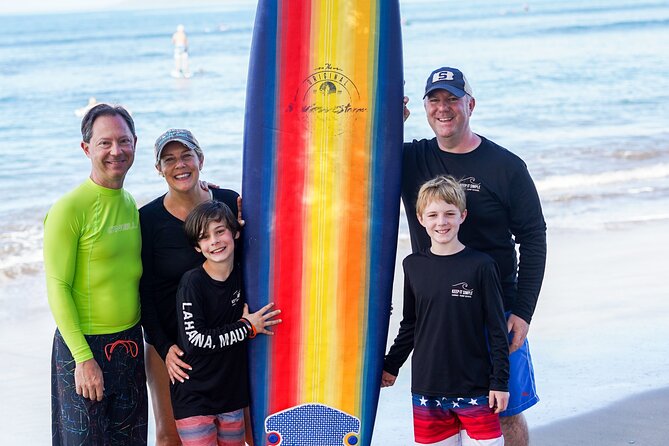
The best part of this Lahaina surf lesson is the private group format. Your family or friends get the instructors to yourselves, with a strong 3-to-1 student-to-instructor ratio and no strangers mixed into the class. The opening beach lesson covers safety, paddling, standing up, and wave timing before you take those skills into the water.
I like the patient, encouraging coaching, especially for children, nervous beginners, and adults who assume surfing is only for the young. I also like that the whole family can participate, from children as young as 8 or 10 in the reported sessions to parents and grandparents. The main consideration is that the $125 price is per person, and you will need to bring your own towel, sunscreen, and drinking water.
Key points before you book
- Private groups of up to 12: Only your own family or travel party joins the lesson.
- A 20 to 25 minute beach briefing: You learn the basics on land before entering the water.
- Roughly 90 minutes of surfing: Instructors help push you into waves and give hands-on support.
- A 3-to-1 student-to-instructor ratio: Larger private groups can still receive close attention.
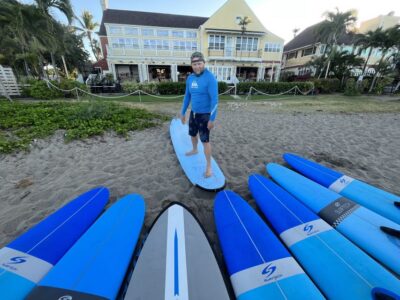
- Equipment is supplied: The price includes a surfboard, water shoes, and rashguard.
- Two lesson times: You can choose between two available start times to fit your day.
Why this private Lahaina lesson works for first-time surfers
Surfing can look easy from the beach. It is not. You need to paddle at the right moment, keep the board straight, push up quickly, and place your feet without losing balance. A crowded group lesson can leave you watching other people catch waves instead of getting useful instruction.
This experience deals with that problem through a private booking. Your group stays together, and the instructors can adjust the lesson to your ability. A family with children, teens, and adults can all take part without being split among strangers or forced into a single pace.
The 3-to-1 ratio matters most once you enter the water. One instructor can help position a board, another can coach someone preparing to stand, and another can keep an eye on the rest of the group. For a private party of up to 12, that is still a busy session, but it is far more personal than a large public class.
I would choose this format for first-time surfers who want a real chance to stand up. It is also useful if one person in your group is nervous or needs extra help. Instructors have worked with complete beginners, older adults, teenagers, and children, and the coaching is adjusted to the comfort level of the person on the board.
More Group Surf Lessons in Maui
- Maui: Two Hour Beginner Group Surf Lesson in Kihei
★ 5.0 · 950 reviews - Group Surf Lesson at Kalama Beach in Kihei
★ 5.0 · 264 reviews - Maui Lahaina Group Surf Lesson
★ 4.9 · 235 reviews
The first 20 to 25 minutes: learning on shore
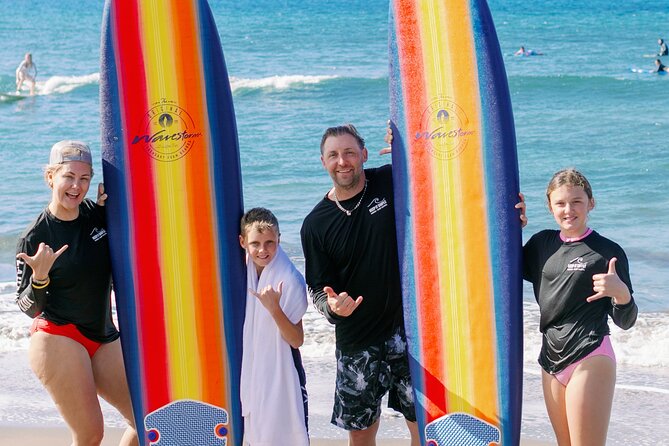
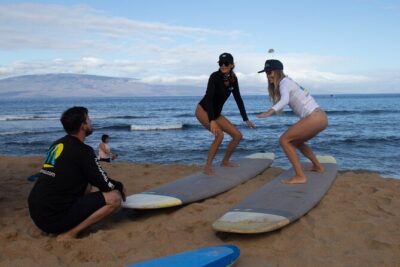
The lesson begins with a land session lasting about 20 to 25 minutes. This is not filler. It gives you a place to make mistakes before the board is moving beneath you.
You learn basic water safety, paddling technique, the pop-up motion, and the mechanics of riding your first wave. The instructor demonstrates the body position and shows you how to move from lying on your stomach to standing. For children, this early practice makes the first water attempt less confusing. For adults, it gives you a chance to understand the motion before fatigue sets in.
The on-shore demonstration has earned specific praise from people who worked with Mario, Luke, Mack, Austin, Ramon, and other instructors. The useful point is not the individual name as much as the teaching pattern: clear instructions first, then repeated feedback after each attempt.
Take this part seriously. Keep your eyes on the demonstration, ask questions, and practice the pop-up with purpose. The more familiar that movement feels on land, the more attention you can give to balance once a wave reaches you.
About 90 minutes in the water
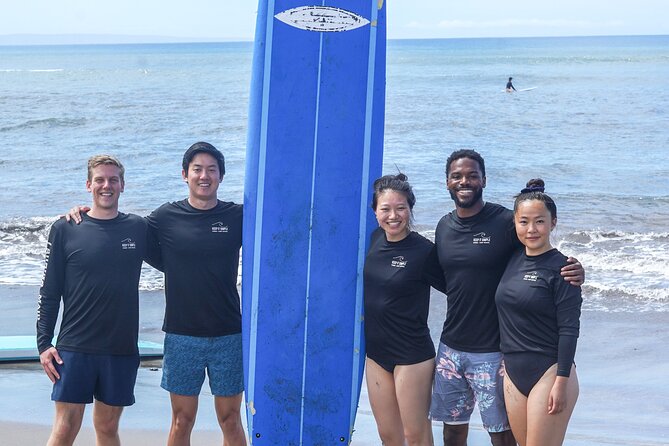
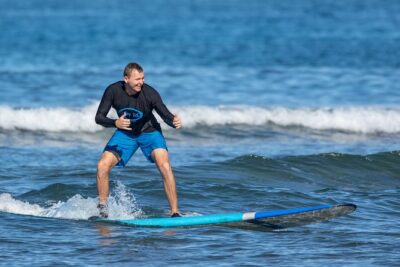
After the beach briefing, the rest of the two-hour session takes place in the ocean. Your instructor helps you catch waves through positioning, wave-pushing, and support in the water. This is the part that turns a lesson into an actual surfing experience instead of a short demonstration.
For many beginners, the first goal is simply standing up. Several family groups managed that during their first session, including groups with two adults and two teenagers, parents with boys aged 10 and 16, and a multigenerational party with children and grandparents. Some people caught a first wave quickly, while others needed more attempts. That difference is normal.
The instructors appear to focus on keeping the mood positive without pretending every attempt will work. If your feet land in the wrong place or you rise too early, you get a correction and another chance. One group specifically needed extra help with a participant who struggled to stand, and the instructors kept working with that person rather than moving on.
Expect to spend much of the water time lying on the board, paddling, waiting, and attempting short rides. That means you may feel tired by the end. One group of four said they surfed so much that they were ready to stop after the lesson, even though they had hoped to continue. Bring energy, but do not plan a demanding activity immediately afterward.
The instructors and the teaching style
The instructors named in the supplied experiences include Mario, Mack, Mac, Austin, Luke, Ramon, Curran, Mateo, and Z. Different sessions may have different staff, so you should not book with the assumption that a particular person will lead your lesson.
The consistent teaching qualities are patience, encouragement, clear instruction, and attention to safety. That combination is especially important when your group includes people with different confidence levels. A strong surfer may want more independence, while a first-timer may need the instructor to help with board position and timing.
The instructors also give feedback after individual waves. That is valuable because beginners often cannot tell why one attempt worked and the next one failed. A short correction about paddling, hand position, or foot placement can make the next attempt much better.
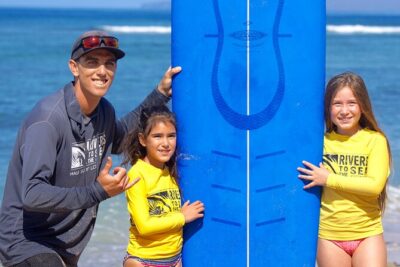
I would consider this a good match for a family that wants instruction without a stern classroom feeling. Children have been a major part of the sessions, and the teaching style appears playful while still keeping the basics in place. Adults also receive active coaching rather than being treated as spectators.
More Group Surf Lessons in the USA
- 2 Hour Beginner Group Surf Lessons
★ 5.0 · 154 reviews - Group Surf Lessons from Kaanapali Beach
★ 5.0 · 143 reviews - Semi-Private Surf Lesson at Kalama Park in Kihei
★ 5.0 · 102 reviews - Group Surf Lesson at Ka’anapali Beach
★ 4.5 · 82 reviews
What the group size means in practice
The private format allows up to 12 people from one family or travel group. You will not be mixed with strangers, which is a major advantage if your party wants to learn together or share the same memory.
The 3-to-1 ratio is strongest for small and medium groups. A party of three or four should receive plenty of direct attention. A party of eight or more will still have multiple instructors, but you should expect some waiting between attempts while other members catch waves.
This is a useful distinction. Private does not mean one instructor dedicated to one person. It means the booking belongs to your group and the staff can shape the session around your party. If everyone is a complete beginner, that shared learning curve can be fun. If abilities vary widely, tell the instructors what each person needs at the start.
The format also suits multigenerational groups. Surfing is not limited to children, and the experience has worked for parents, grandparents, teens, and younger children in the same session. A private class lets the instructors offer more support to the least confident participants without embarrassing them in front of strangers.
Equipment, comfort, and the small things to pack
The $125 fee includes a surfboard, water shoes, and rashguard. Those inclusions remove some of the hassle from a first lesson, since you do not need to rent basic equipment separately.
You should bring a towel, sunscreen, and water because none of those are supplied. Put sunscreen on areas you might overlook, especially the backs of your legs. You spend a lot of time lying on your stomach while waiting for waves, and one person specifically ended the session with a burn in that spot.
A rashguard helps with comfort in the water, but it does not replace sunscreen. Apply protection before the lesson and pay attention to legs, shoulders, neck, and the backs of your arms. Bring enough drinking water for after the activity, particularly if you are surfing with children.
The meeting point is on Hawaii 30, also called HI-30, in Lahaina, and the activity ends back there. A mobile ticket is accepted, and the lesson is offered in English. Confirmation arrives at booking, so keep the booking details available on your phone.
Price and value at $125 per person
At $125 per person, this is not the cheapest way to spend two hours in Maui. The value comes from the private setup and the amount of instruction, not from the length alone.
A public group lesson may cost less, but you could spend more time waiting or sharing an instructor with people you do not know. Here, the whole booking is built around your own group, and the price includes the board, rashguard, and water shoes. For a family that wants everyone involved, that can make the total easier to justify.
The value is strongest when several people in your group are beginners. If only one person wants to surf and everyone else is watching, a private group booking may not make financial sense. If four, six, or eight relatives all want to try, the shared experience becomes the point.
Optional photographs are available for purchase after the lesson. One group reported paying $110 for photos of three people, while other groups also praised the shore photographer. Treat this as an extra, not part of the $125 lesson price, and confirm the current cost before buying.
What the experience cannot promise
The lesson is designed to help beginners succeed, but no surf school can promise that every person will stand on every wave. Ocean conditions, timing, balance, fitness, and comfort in the water all affect the result.
The conditions reported in the experiences included easy, lower surf on at least one day. That can be helpful for learning, but conditions vary. A calm session may be ideal for children and nervous adults, while a more active ocean can make the lesson harder.
The activity requires good weather. If poor weather forces cancellation, you are offered another date or a full refund. You can cancel for a full refund if you do so at least 24 hours before the start time. Cancellations or changes made inside 24 hours are not refunded or accepted.
The supplied information says most people can participate, but it does not provide detailed medical, age, or mobility requirements. If someone in your party has a concern about swimming, balance, or physical exertion, ask the operator before booking.
Who should book this surf lesson
I would recommend it most strongly to families, couples, and friend groups where several people want to try surfing for the first time. The private structure keeps the session personal, and the instructors have experience helping children, teens, adults, and older beginners.
It is also a good choice for nervous beginners. You receive an explanation on land, then coaching in the water, with staff available to help position the board and encourage another attempt. That steady support can make the difference between an enjoyable first ride and a frustrating morning.
A group with some prior experience may also benefit, since the instructors can offer tips rather than starting every person from the same point. Still, this is primarily a beginner-friendly lesson, not an advanced surf clinic.
I would be more cautious if your group has no interest in getting wet, dislikes physical effort, or expects a guaranteed long ride on the first try. You will paddle, wait, fall, try again, and possibly feel tired before the two hours are finished.
Should you book it?
Book this lesson if your group wants a shared Maui activity with a genuine chance to catch waves, especially if you have children, nervous first-timers, or several different ages. The private format, included equipment, and close instructor ratio give it a clear advantage over a crowded beginner class.
At $125 per person, it is best viewed as a hands-on experience rather than a simple rental. Pack sunscreen, water, and a towel, leave room for repeated attempts, and consider the optional photos if you want a record of the first rides.
I would skip it only if the price is too high for your group or if some members do not want to participate. For a family that wants everyone in the water together, this is a strong, practical choice in Lahaina.
FAQ
Where does the surf lesson meet?
The meeting point is on Hawaii 30, also identified as HI-30, in Lahaina, Hawaii. The activity ends back at the meeting point.
How long does the lesson last?
The lesson lasts approximately two hours. About 20 to 25 minutes are spent on land, with the remaining time in the water.
Is the lesson private?
Yes. Only your own family or travel group participates, and your group is not combined with strangers. The private booking can include up to 12 people from the same group.
What is the student-to-instructor ratio?
The experience provides a 3-to-1 student-to-instructor ratio. The exact number of instructors depends on the size of your private group.
What equipment is included?
The price includes a surfboard, water shoes, and rashguard.
What should I bring?
Bring a towel, sunscreen, and water. These items are not included.
Is the lesson suitable for beginners and children?
The lesson is designed for different ability levels, and most people can participate. Children, teens, adults, and older beginners have taken part in the sessions described.
What happens if the weather is poor?
The activity requires good weather. If it is canceled because of poor weather, you can choose another date or receive a full refund. For your own cancellation, you must cancel at least 24 hours before the start time for a full refund.
More Private Surf Lessons in the USA
- 2 Hour Private Surf Lesson in Lahaina
★ 5.0 · 83 reviews - Semi-Private Surf Lesson at Ka’anapali Beach
★ 4.5 · 76 reviews - Semi-Private Surf Lesson – 3 Students 1 Instructor
★ 4.5 · 73 reviews - Private Beginner Paddleboard 101 Lesson: Makena Landing!
★ 5.0 · 68 reviews
More Private Surf Lessons in Maui
- Private Stand Up Paddle Boarding Tour in Turtle Town, Maui
★ 5.0 · 293 reviews - Private Surf Lesson for Two Near Lahaina
★ 5.0 · 189 reviews - 2 Hour Private Surf Lesson For Two In Lahaina
★ 5.0 · 102 reviews - Private Surf Lesson for Group of 3-5 Near Lahaina
★ 5.0 · 93 reviews
Just added around Maui
- Epic Surf Safari – Best of Maui★ 5.0 · 4 reviews
- Surf with ALOHA SURF SCHOOL★ 5.0 · 9 reviews
- 2-Hour Semi Private Hawaiian Surf Lesson with the best in Maui..★ 5.0 · 15 reviews
- 2-Hour Surf Lessons with a Pro★ 3.5 · 3 reviews
- Private Surf Lessons in Maui★ 5.0 · 2 reviews
- Private Surf Lessons in Lahaina, Maui★ 5.0 · 31 reviews
- Private Surf Lesson at Kalama Beach in Kihei★ 5.0 · 25 reviews
- Semi-Private Surf Lesson at Kalama Beach in Kihei★ 5.0 · 25 reviews
Maui Surf Trips, compared.


Private Stand Up Paddle Boarding Tour in Turtle Town, Maui
Read our review →